
Template preview
Open full ↗
Toko Online
Outdoor Gear
"Use" opens the PageHub dashboard so you can start from this template.
- Category
- Toko Online
- Type
- Multi-page website
- Pages
- 4
- Online store
- Included
- Published
- 16 November 2026
- Used
- Never used
Outdoor Gear is a complete online shop for a lightweight hiking and backpacking brand: four pages plus catalogue, product page, cart, checkout and a journal. It is built on one number the outdoor trade likes to fudge — the weight — which every product card shows as its headline figure, measured as carried, with stakes and stuff sacks included.
Pages included
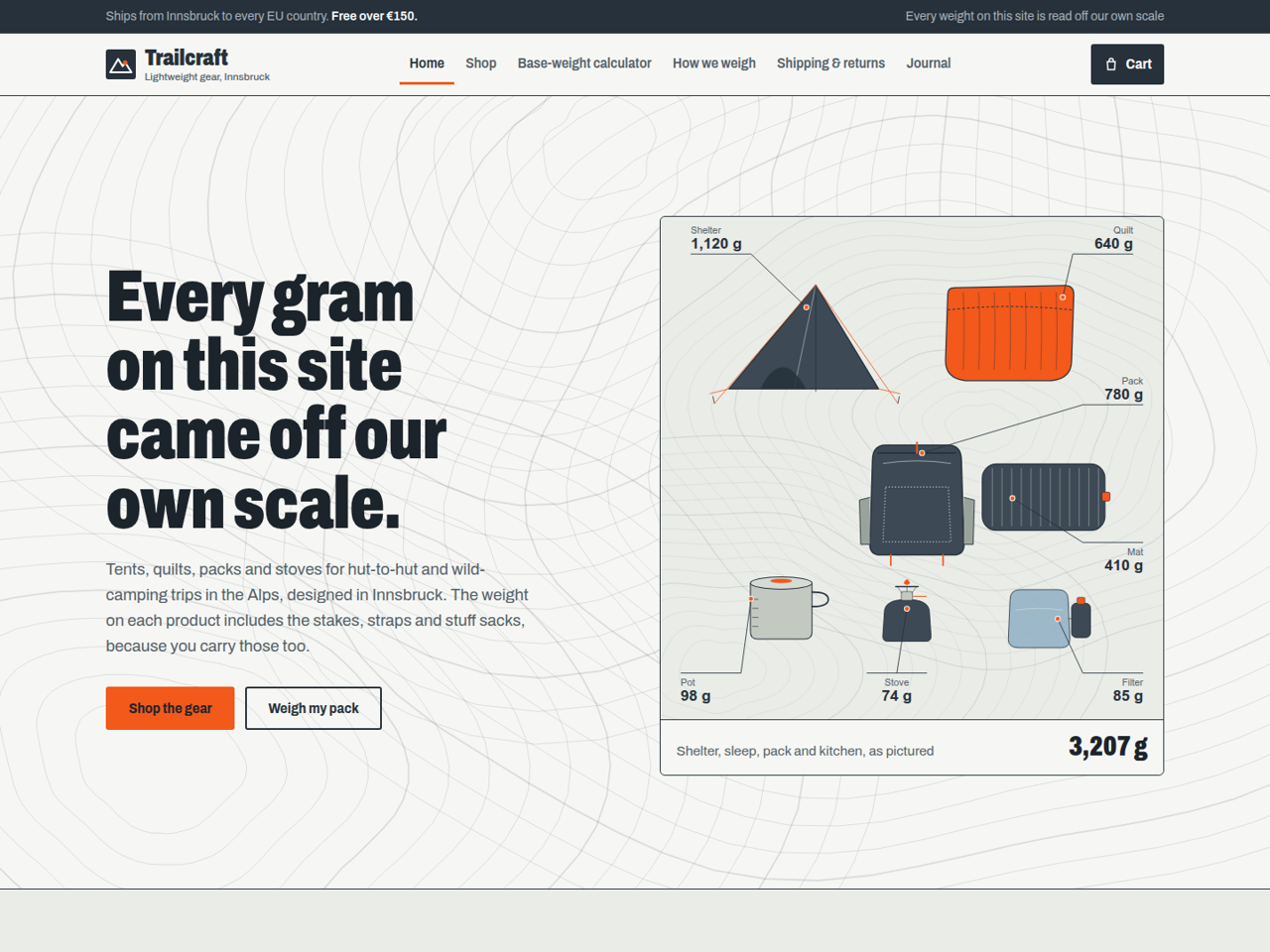
Home — a hero with a hand-drawn flat lay of seven items on a topographic map, each labelled in grams and summed underneath; two live product strips (featured and newest); a part-by-part table showing why a tent sold at 1,120 g would be printed at 950 g elsewhere; a calculator preview; and three products the shop talks people out of buying, with the figure that justifies each.
Base-weight calculator — the signature mechanism. A gear list in six categories, each item ticked on or off with an editable gram figure. It totals the base weight, names the class (traditional, lightweight, ultralight), draws a bar per category and flags the heaviest. Then, in order of value: what leaving things at home saves for €0, the biggest paid swap in the heaviest category priced in euros per 100 g saved, and a verdict for the trip length chosen. For a weekend it often says plainly that the ultralight swap is not worth the money. Packs are deliberately suggested last, and the essentials have no swap at all.
How we weigh — the method in four steps, one batch log written down, a table of exactly what each product's weight includes, and why a customer's kitchen scale may disagree.
Shipping & returns — EU shipping zones with carrier, transit and price, returns and repair price tables, and an accessible FAQ accordion.
Shop, product, cart, checkout — the gram figure is lifted out of the product name onto the card and the product page; category chips, working gallery, variants, a product page that links into the calculator, and a checkout with email, phone and order note.
Journal — three long posts: the 1.1 kg nobody uses, when a lighter tent is not worth it, and the three repairs the desk does most.
Design and style. Granite and slate with a safety-orange signal colour, topographic contour linework, Archivo throughout with its condensed widths for numbers and headlines, ruled spec tables with tabular figures. All product and journal images are hand-drawn SVGs. The shared script is vanilla and null-guarded, since it runs on every page.
Before you publish. Weights live in the product name as “Name (1,120 g)”; the script turns that into the big number, and a name without it simply shows no figure. The calculator's items, weights, swap prices and links are data- attributes on each row — update them to your own products, and keep the per-trip limits in the script in line with the table on the same page. The home page's sample totals and the Corvara breakdown are worked examples that add up; recheck them after editing. Shipping prices, the 60-day return and the five-year repair promise are commitments customers will hold you to. Forms use named inputs with no action attribute, so PageHub attaches the handler on publish; sample products and articles are for the preview only.
Best suited to outdoor and camping shops, bike-packing and climbing gear, running and travel equipment, and any store where a measured spec is the reason people buy — and where the honest answer is sometimes to keep what you have.
No reviews yet. Reviews come from people who actually used this template.