
Template preview
Open full ↗
Toko Online
Homebrew Beer Kits
"Use" opens the PageHub dashboard so you can start from this template.
- Category
- Toko Online
- Type
- Multi-page website
- Pages
- 4
- Online store
- Included
- Published
- 16 November 2026
- Used
- Never used
Homebrew Beer Kits is a complete online shop for a homebrew supply store: four pages plus catalogue, product page, cart, checkout and a journal. It is built around the brew log — gravity readings, yeast ranges and the room the fermenter stands in — and one working mechanism: a brew calculator that will tell a buyer when a kit is wrong for them.
Pages included
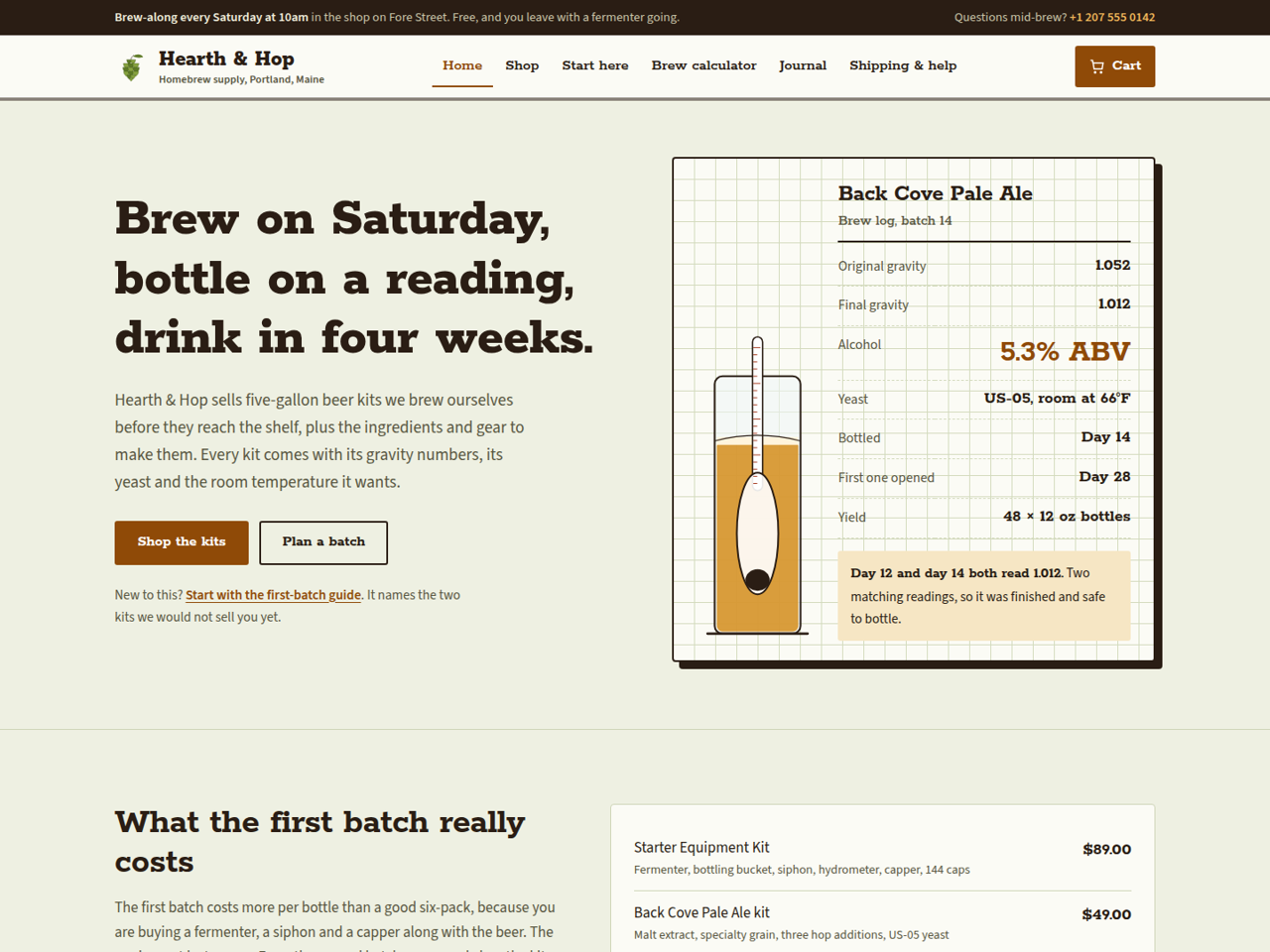
Home — a filled-in brew log as the hero (OG, FG, ABV, bottling day, yield) beside a hydrometer in its trial jar, a first-batch receipt that adds up exactly ($89 equipment + $49 kit = $138, $2.88 a bottle the first time and $1.02 after), two live product strips (featured and newest), a dark band showing what the calculator says about a lager in a warm apartment, a kit-by-room table with the colour of each finished beer, and two customer notes, one of them about a batch that went wrong.
Start here — what is in the starter kit, what you need from the kitchen and what to leave on the shelf; the four weeks day by day; three ways first batches fail; and two kits the shop will not sell a beginner yet, with the reason for each.
Brew calculator — pick a kit, a brew date and the room temperature (°F or °C), enter OG and FG. It computes ABV and attenuation, draws both readings on a hydrometer scale, gives a bottling date and a first-drink date, adds days when the room is cool, refuses to give a date when it is too cold, warns when the beer will run above the yeast's range, tells you not to bottle when the final gravity is still high, and says plainly when a kit is not for a first batch. Below it: the formula with a worked example, the kit table it reads from, and a short FAQ.
Shipping & help — rates table, yeast in hot weather, a three-way returns policy, opening hours and a contact form.
Shop, product, cart, checkout — catalogue with category tabs, product page with gallery and a spec sheet, a cart that reminds you about the hydrometer, and a checkout with email, phone and an order note.
Journal — three long posts: bottling on readings rather than dates, brewing in a warm apartment, and what the three hop additions do.
Design and style. Pale ledger-green paper with a quarter-inch grid where something is being recorded, stout-brown ink, an amber-brown accent and hop green for good news. Rokkitt slab headings over Source Sans 3, square shadows like a clipboard, a solid header with a double rule. Product photos are hand-drawn kit boxes whose label shows the colour of the beer. The shared script carries the menu, gallery, accordions and calculator — all vanilla and null-guarded.
Before you publish. The calculator reads each kit's gravity, yeast range and day counts from data- attributes on its kit list; the same figures are printed in the tables on the home and calculator pages, in the product descriptions and in one journal post, so change them together. The cost receipt sums to the prices above it. Shipping rates, the 2pm dispatch cut-off and the returns rules are promises customers will hold you to. Sample products and articles are for the preview only.
Best suited to homebrew and winemaking suppliers, coffee and tea equipment shops, fermentation and cheesemaking kits, and any shop whose customers need a number worked out before they buy.
No reviews yet. Reviews come from people who actually used this template.