
Vorlagen-Vorschau
Vollbild öffnen ↗
Rumah Ibadah
Mosque
„Verwenden" öffnet das PageHub-Dashboard, damit du mit dieser Vorlage starten kannst.
- Kategorie
- Rumah Ibadah
- Typ
- Mehrseitige Website
- Seiten
- 5
- Onlineshop
- Nicht enthalten
- Veröffentlicht
- 1 September 2026
- Verwendet
- Noch nie verwendet
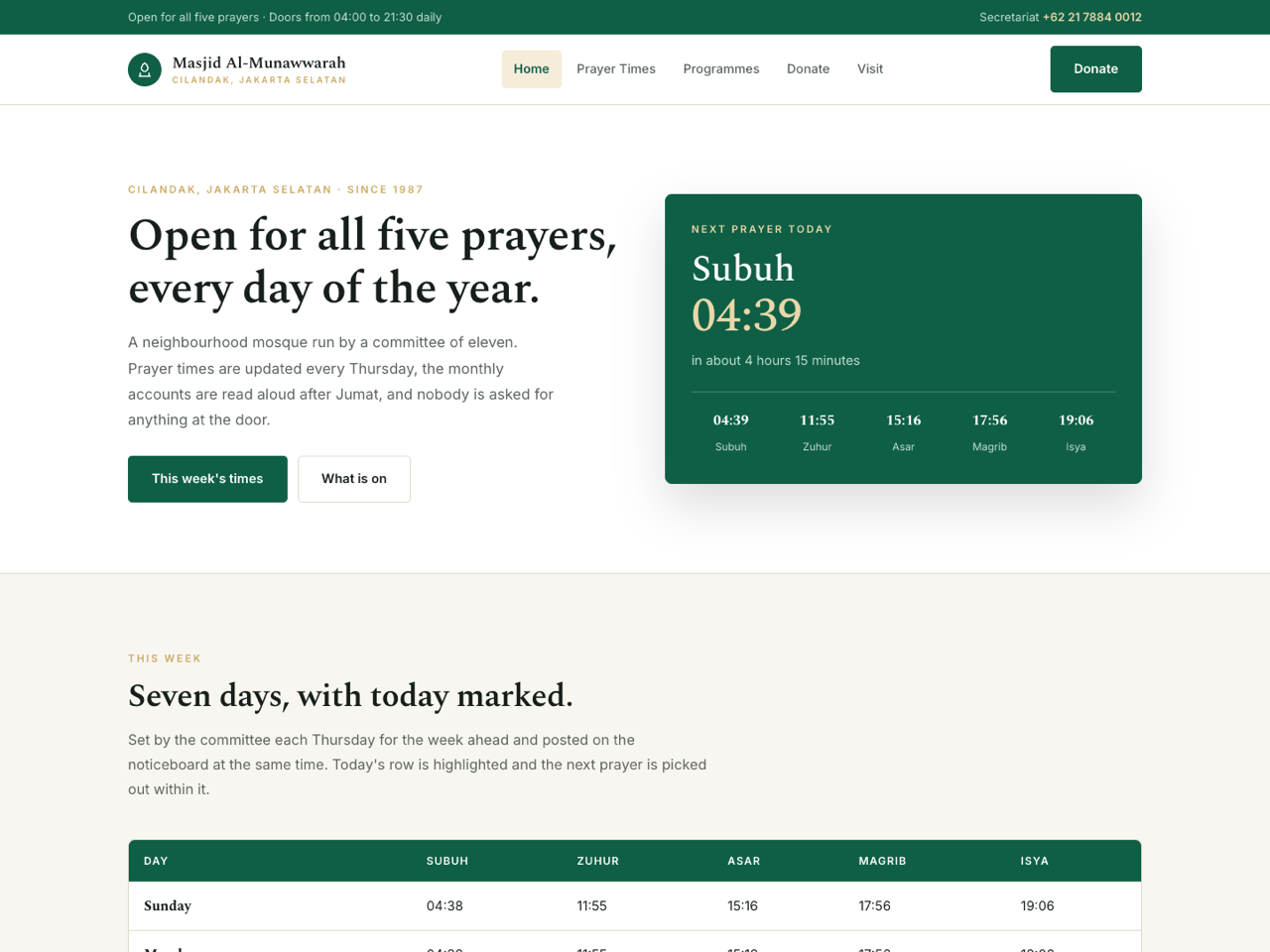
Mosque is a five-page website for a neighbourhood place of worship, built around two things a congregation actually needs from a website: when the next prayer is, and where the money went. Two working mechanisms carry it: a prayer timetable that marks today's row and picks out the next prayer, and donation bars that derive their percentage and their shortfall from the raised and target figures, so a bar can never disagree with the number beside it.
Pages included
Home — a hero card showing the next prayer, its time and how long until it, beside the week's full table with today highlighted; six weekly programmes; two funding appeals with live progress; and last year's income split down to the twelve per cent that pays the staff.
Prayer Times — the iqamah intervals with the reason for each, a month of Subuh and Magrib day by day (the two that actually move; the other three shift by under two minutes and stay on the weekly table), the Friday timetable minute by minute, what changes in Ramadan, and five questions including an honest answer about why a phone app shows a different Subuh.
Programmes — nine recurring activities with day, time and what actually happens; four services offered at no charge including funeral rites and nikah; last year's four totals; and three ways to help of which only one is money.
Donate — the two open funds again with live bars, an optional form with amount chips, three bank accounts with copy buttons that strip the display spaces before the clipboard, a dark band of last year's spending including a zero line, and a section on zakat being banked separately and never touched.
Visit — five things to do in order on a first visit, a "worth knowing / not a problem" pair where the second list is deliberately longer, directions with both entrances, facilities with an honest note about the step that is not yet accessible, and a contact form that tells bereaved families to telephone instead.
Design and style. Deep green and gold on warm cream, Spectral over Inter, calm spacing, a sticky solid header above a green utility strip. The shared script carries the menu, the prayer highlighting, the funding bars, accordions, amount chips and clipboard copy — all vanilla and null-guarded, since it runs on every page.
Before you publish. Prayer times are typed into the page and read back by the script, never calculated — that is deliberate, because choosing a calculation method on a visitor's behalf and being four minutes out is worse than showing nothing. Which means the week table must actually be updated every week and the month table every month; if you will not, replace them with a link to your printed sheet. The hero strip's five times are filled from today's row by the script rather than typed, so they cannot drift from the table; the numbers in the markup are only the no-JavaScript fallback. Every fund figure lives in data-raised and data-target; the bar, the percentage and the shortfall all come from those two. The published accounts, the "no charge, ever" services and the unpaid committee are commitments, not decoration. Forms use named inputs with no action attribute, so PageHub attaches the handler on publish and messages arrive in Form Submissions with the fund and amount attached.
Best suited to mosques, churches, temples and other places of worship, community and neighbourhood associations, charitable foundations, and any organisation whose credibility rests on publishing what it received and what it spent.
Pages included
Home — a hero card showing the next prayer, its time and how long until it, beside the week's full table with today highlighted; six weekly programmes; two funding appeals with live progress; and last year's income split down to the twelve per cent that pays the staff.
Prayer Times — the iqamah intervals with the reason for each, a month of Subuh and Magrib day by day (the two that actually move; the other three shift by under two minutes and stay on the weekly table), the Friday timetable minute by minute, what changes in Ramadan, and five questions including an honest answer about why a phone app shows a different Subuh.
Programmes — nine recurring activities with day, time and what actually happens; four services offered at no charge including funeral rites and nikah; last year's four totals; and three ways to help of which only one is money.
Donate — the two open funds again with live bars, an optional form with amount chips, three bank accounts with copy buttons that strip the display spaces before the clipboard, a dark band of last year's spending including a zero line, and a section on zakat being banked separately and never touched.
Visit — five things to do in order on a first visit, a "worth knowing / not a problem" pair where the second list is deliberately longer, directions with both entrances, facilities with an honest note about the step that is not yet accessible, and a contact form that tells bereaved families to telephone instead.
Design and style. Deep green and gold on warm cream, Spectral over Inter, calm spacing, a sticky solid header above a green utility strip. The shared script carries the menu, the prayer highlighting, the funding bars, accordions, amount chips and clipboard copy — all vanilla and null-guarded, since it runs on every page.
Before you publish. Prayer times are typed into the page and read back by the script, never calculated — that is deliberate, because choosing a calculation method on a visitor's behalf and being four minutes out is worse than showing nothing. Which means the week table must actually be updated every week and the month table every month; if you will not, replace them with a link to your printed sheet. The hero strip's five times are filled from today's row by the script rather than typed, so they cannot drift from the table; the numbers in the markup are only the no-JavaScript fallback. Every fund figure lives in data-raised and data-target; the bar, the percentage and the shortfall all come from those two. The published accounts, the "no charge, ever" services and the unpaid committee are commitments, not decoration. Forms use named inputs with no action attribute, so PageHub attaches the handler on publish and messages arrive in Form Submissions with the fund and amount attached.
Best suited to mosques, churches, temples and other places of worship, community and neighbourhood associations, charitable foundations, and any organisation whose credibility rests on publishing what it received and what it spent.
Noch keine Bewertungen. Bewertungen stammen von Leuten, die diese Vorlage wirklich benutzt haben.