
Vorlagen-Vorschau
Vollbild öffnen ↗
Allgemein
Daycare & Preschool
„Verwenden" öffnet das PageHub-Dashboard, damit du mit dieser Vorlage starten kannst.
- Kategorie
- Allgemein
- Typ
- Mehrseitige Website
- Seiten
- 5
- Onlineshop
- Nicht enthalten
- Veröffentlicht
- 16 November 2026
- Verwendet
- Noch nie verwendet
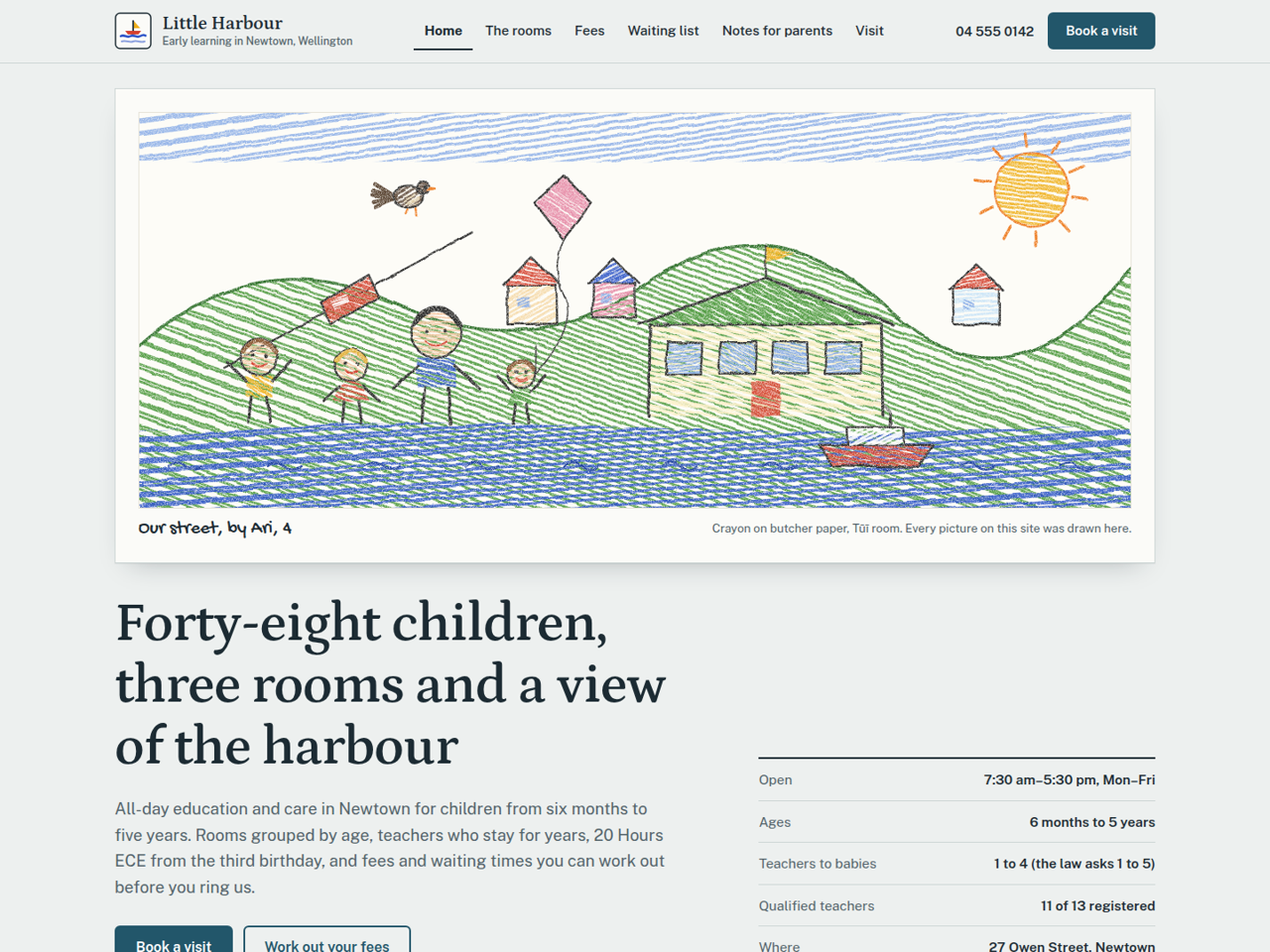
Daycare & Preschool is a five-page website plus a parents’ journal for an all-day early learning centre with three rooms by age (babies, toddlers, preschool). Its look comes from the children themselves: every image is a crayon drawing, hung in a mat-board frame with a handwritten wall label, while the type, tables and tools around them stay calm and grown-up. Two mechanisms actually run, and both will tell a parent something unwelcome.
Pages included
Home — a framed hero drawing with the headline beneath it like a gallery label and a fact list (hours, ages, ratios), the three rooms with their group sizes, ratios and hourly fees, a timed day in the preschool room, a worked 20 Hours ECE example on a dark band, a room-by-room table of waiting times, three parent quotes and a visit call to action.
The rooms — a comparison table against the legal ratios, then one section per room (how the day runs, what to bring), the four-step settling-in plan and the teaching team with years of service.
Fees — the fee calculator: child’s age, days a week and hours a day, hours already claimed at another service, and the optional charge. It applies New Zealand’s 20 Hours ECE honestly (from age 3 only, at most 6 funded hours a day and 20 a week, across two services at most) and returns a weekly and a 10-week term cost with a line-by-line breakdown, plus advice such as how many funded hours a pattern wastes and what fixing that would really cost. Then the hourly rate table, the funding rules in plain words, other help it deliberately does not estimate, and a fee FAQ.
Waiting list — the waiting-list estimator: room, part or full week, and hoped-for start month (labelled from today’s date). It uses families ahead and monthly openings per room to give a likely month with an early–late range, and says plainly when the wait is long, including when it is longer than a child would spend in that room. Then the order in which places are offered, the figures behind the estimate and what to do while waiting.
Visit — one enquiry form for a visit, a waiting-list place or both (parent, child, date of birth, days, visit slot), contact details, a drawn map and getting-there notes.
Notes for parents — blog list and article templates, with three sample articles on settling in, 20 Hours ECE worked through with the centre’s fees, and what to pack for each room.
Design and style. Harbour blue and fog grey with a crayon set (yellow, green, blue) that only appears in the drawings and as one colour per room; Petrona headings, Public Sans text and Gochi Hand for the children’s captions; ten hand-drawn crayon SVGs. Prices are in New Zealand dollars.
Before you publish. Hourly rates and the optional charge live in the calculator’s data-rate-* and data-optional attributes and are repeated on Home, the rate table and one article. Waiting-list figures live in the estimator’s room options (data-ahead-*, data-open-*) and are repeated in two tables; update all of them together each month.
Noch keine Bewertungen. Bewertungen stammen von Leuten, die diese Vorlage wirklich benutzt haben.