
Template preview
Open full ↗
Toko Online
Fashion Women
"Use" opens the PageHub dashboard so you can start from this template.
- Category
- Toko Online
- Type
- Multi-page website
- Pages
- 4
- Online store
- Included
- Published
- 1 September 2026
- Used
- Never used
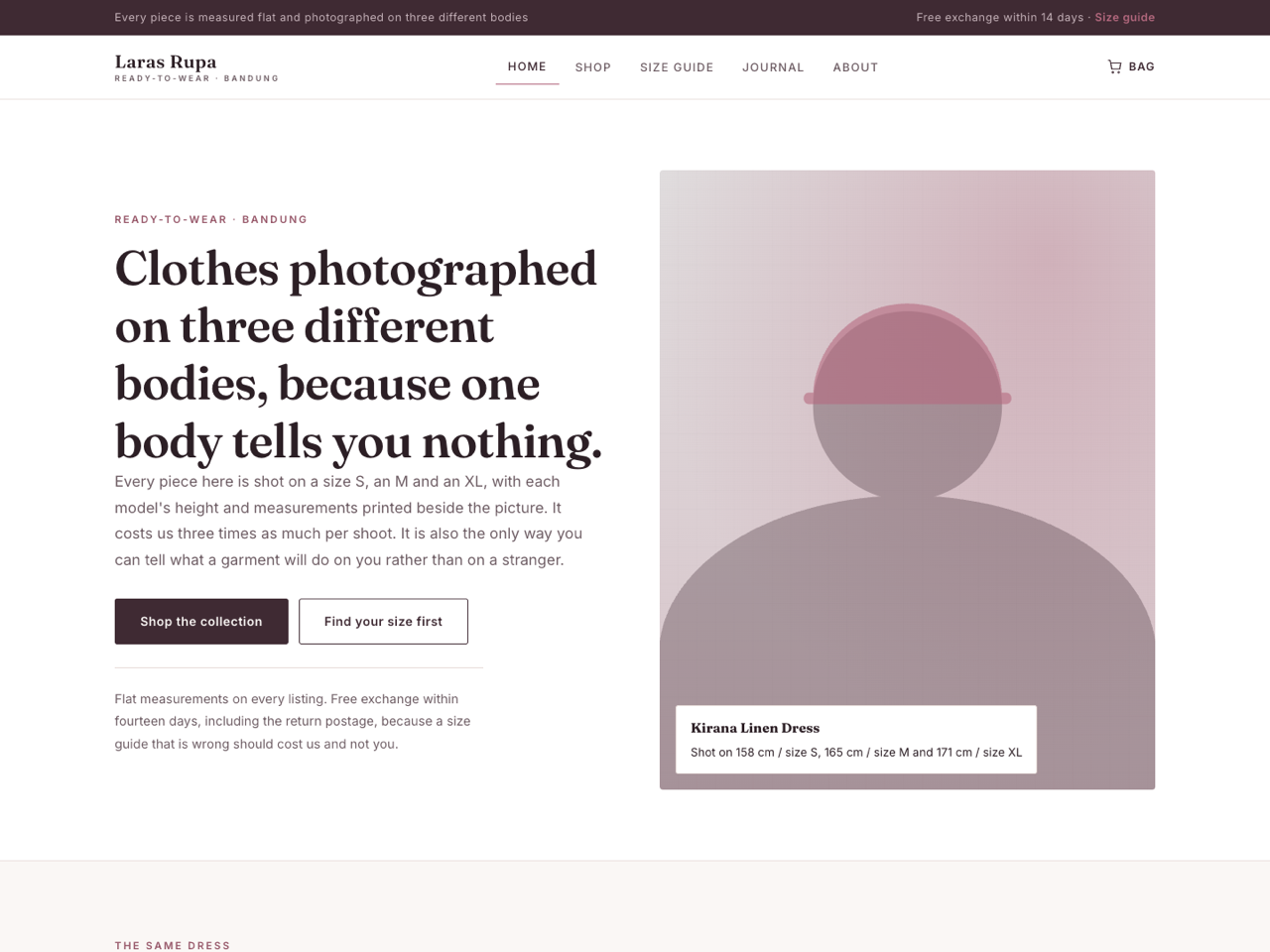
Fashion Women is a full online shop for a small ready-to-wear label: four pages plus catalogue, product, bag, checkout and a journal. It is built on one habit the trade avoids — every piece is photographed on three different bodies, with each model's height and measurements printed underneath. The working mechanism is a size recommender that reads the size chart printed on the same page, so the tool and the table can never disagree.
Pages included
Home — hero on why one body tells you nothing, the same dress on a 158 cm, a 165 cm and a 171 cm model with what the hem does on each, a live product strip filled from the catalogue, a dark band on why four fifths of exchanges are one size out, three facts about small runs (two of them inconvenient), and three customers including one who had to exchange.
Size guide — the recommender: bust, waist and hip in centimetres against six sizes whose body ranges live in data-bust, data-waist and data-hip on the chart rows themselves. It prints one size when all three agree, and when they do not it says so, names which measurement went where, gives the larger size and explains why a seam can be taken in but rarely let out. Your row lights up in the chart as you type. Then how to measure, the two exceptions to sizing up, and six questions including what happens when you are past the largest size.
Shipping & returns — five destinations with real courier prices and no free-shipping threshold, the four WhatsApp messages an order produces, an accepted/refused payment pair that explains why each is refused, and a returns policy that separates free exchanges from you-pay refunds, with an exchange form.
About — nine people on one floor, three of them named with what they actually decide, a Rp 549.000 dress broken down into six lines that sum to the price including what the free-exchange policy costs everyone, three things the workshop is honestly bad at, and the studio address.
Shop, product, bag, checkout — catalogue with category chips, a product page with a working thumbnail gallery and a link into the size guide, a bag, and a checkout that says plainly nothing is reserved until payment lands.
Journal — four long posts: washing linen, why a best-selling pattern was retired with the exchange figures that forced it, what a run of fifty actually costs line by line, and how the three-body shoot works including what is never retouched.
Design and style. Plum and dusty rose on warm off-white, Fraunces over Inter, near-square corners, a quiet sticky header with a bag link. The shared script carries the menu, the size recommender, the product gallery and accordions — all vanilla and null-guarded, since it runs on every page.
Before you publish. The size chart is the single source: the tool reads those six rows, so editing a row changes the recommendation with nothing else to keep in step — but the ranges must stay in ascending order and must not overlap. Replace the measurements with your own before anything else: a size guide is a promise, and an inherited one will send you real parcels in both directions. The cost breakdown on the About page sums exactly to the price above it — change one line and the arithmetic must still land. The three-body photography, the free exchange and the courier prices are commitments a customer will hold you to. Forms use named inputs with no action attribute, so PageHub attaches the handler on publish; sample products and articles are for the preview only and never reach your catalogue.
Best suited to ready-to-wear and modest-wear labels, small ateliers and made-to-order studios, and any clothing shop whose returns are mostly about fit rather than taste — where a size guide that admits the awkward cases is worth more than one that never does.
Pages included
Home — hero on why one body tells you nothing, the same dress on a 158 cm, a 165 cm and a 171 cm model with what the hem does on each, a live product strip filled from the catalogue, a dark band on why four fifths of exchanges are one size out, three facts about small runs (two of them inconvenient), and three customers including one who had to exchange.
Size guide — the recommender: bust, waist and hip in centimetres against six sizes whose body ranges live in data-bust, data-waist and data-hip on the chart rows themselves. It prints one size when all three agree, and when they do not it says so, names which measurement went where, gives the larger size and explains why a seam can be taken in but rarely let out. Your row lights up in the chart as you type. Then how to measure, the two exceptions to sizing up, and six questions including what happens when you are past the largest size.
Shipping & returns — five destinations with real courier prices and no free-shipping threshold, the four WhatsApp messages an order produces, an accepted/refused payment pair that explains why each is refused, and a returns policy that separates free exchanges from you-pay refunds, with an exchange form.
About — nine people on one floor, three of them named with what they actually decide, a Rp 549.000 dress broken down into six lines that sum to the price including what the free-exchange policy costs everyone, three things the workshop is honestly bad at, and the studio address.
Shop, product, bag, checkout — catalogue with category chips, a product page with a working thumbnail gallery and a link into the size guide, a bag, and a checkout that says plainly nothing is reserved until payment lands.
Journal — four long posts: washing linen, why a best-selling pattern was retired with the exchange figures that forced it, what a run of fifty actually costs line by line, and how the three-body shoot works including what is never retouched.
Design and style. Plum and dusty rose on warm off-white, Fraunces over Inter, near-square corners, a quiet sticky header with a bag link. The shared script carries the menu, the size recommender, the product gallery and accordions — all vanilla and null-guarded, since it runs on every page.
Before you publish. The size chart is the single source: the tool reads those six rows, so editing a row changes the recommendation with nothing else to keep in step — but the ranges must stay in ascending order and must not overlap. Replace the measurements with your own before anything else: a size guide is a promise, and an inherited one will send you real parcels in both directions. The cost breakdown on the About page sums exactly to the price above it — change one line and the arithmetic must still land. The three-body photography, the free exchange and the courier prices are commitments a customer will hold you to. Forms use named inputs with no action attribute, so PageHub attaches the handler on publish; sample products and articles are for the preview only and never reach your catalogue.
Best suited to ready-to-wear and modest-wear labels, small ateliers and made-to-order studios, and any clothing shop whose returns are mostly about fit rather than taste — where a size guide that admits the awkward cases is worth more than one that never does.
No reviews yet. Reviews come from people who actually used this template.