
Template preview
Open full ↗
Franchise & Peluang Usaha
Franchise Partnership
"Use" opens the PageHub dashboard so you can start from this template.
- Category
- Franchise & Peluang Usaha
- Type
- Landing page
- Published
- 1 September 2026
- Used
- 1 time
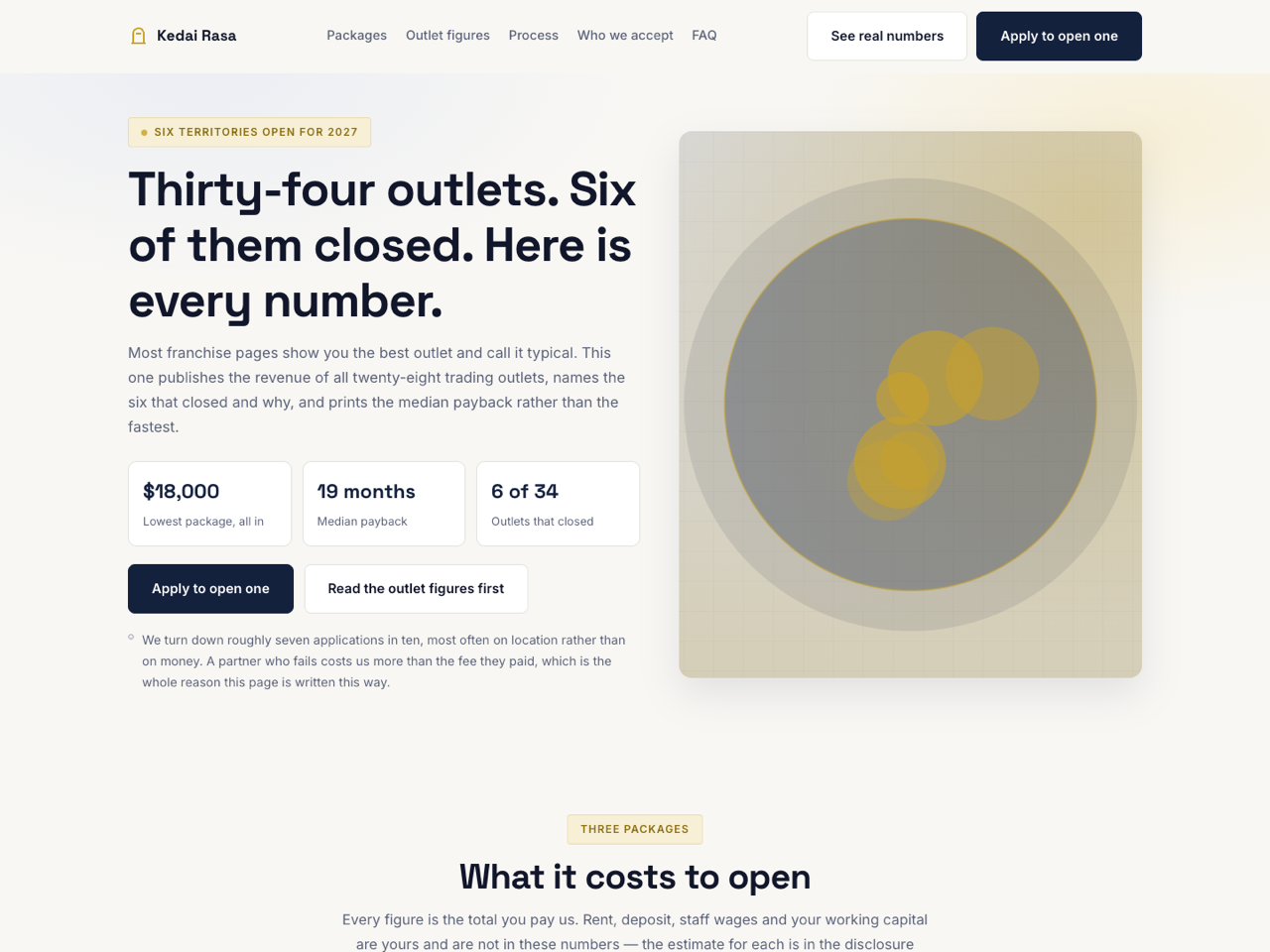
Franchise Partnership is a landing page for selling a business opportunity, and it is written against the grain of its own category. Most franchise pages show the best outlet and imply it is typical. This one publishes the median, the best, the worst and the closures — because the applicant worth having is the one who checks, and the applicant who fails costs the franchisor more than the fee they paid.
Sections, in order
Sticky navbar with anchors and an apply button.
Hero — a headline that leads with the closure count, three KPI tiles (lowest package, median payback, outlets closed), and the statement that seven applications in ten are declined.
Packages — three tiers with what each includes, followed by the ongoing royalty and marketing levy and an explicit note that equipment is not marked up.
What the fee buys / what it is not — two columns, the right-hand one ruling out passive income, guaranteed returns, free rent and a fast opening.
Outlet performance — a dark band carrying a real table: outlets, median monthly sales, best, worst and median payback, with a highlighted row for closed outlets and a paragraph naming why each closed.
Process — five steps from application to opening with weeks attached, including the disclosure pack and a site search either side can veto.
What the royalty pays for — three cards, because a royalty with nothing behind it is a tax.
Who we accept — five numbered, non-negotiable criteria, the first of which is that the owner works in the outlet for a year.
Partner quotes — three, one from someone whose first eight months went badly.
FAQ — six questions: guaranteed returns, mandatory purchasing, what happens on failure, new cities, fee negotiation, when you can take a salary.
Application form — package, city, capital beyond the fee, and a free-text field asking who will actually run the outlet.
Design and style. Serious and commercial: navy and old gold on a warm off-white, Space Grotesk over Inter, square-cornered labels, one dark band for the performance table. FAQ accordion, scroll reveal and mobile menu are vanilla JavaScript.
Before you publish. The performance table is the page. If you cannot publish real figures including your failures, this template will make you look worse than a vague one — a table that shows only successes is the first thing an experienced buyer discounts. Keep the outlet counts identical in the hero tiles, the table and the footer, and make sure the royalty and levy percentages match your agreement exactly. The acceptance criteria should cost you applications; that is what stops the closures. The form uses named inputs with no action attribute, so PageHub attaches the handler on publish and each application arrives in Form Submissions with the package, city and capital band attached.
Best suited to food and beverage franchises, retail and service chains, laundry and car-wash brands, education and tutoring franchises, dealer and distributor recruitment, and any partnership sold on numbers rather than enthusiasm.
Sections, in order
Sticky navbar with anchors and an apply button.
Hero — a headline that leads with the closure count, three KPI tiles (lowest package, median payback, outlets closed), and the statement that seven applications in ten are declined.
Packages — three tiers with what each includes, followed by the ongoing royalty and marketing levy and an explicit note that equipment is not marked up.
What the fee buys / what it is not — two columns, the right-hand one ruling out passive income, guaranteed returns, free rent and a fast opening.
Outlet performance — a dark band carrying a real table: outlets, median monthly sales, best, worst and median payback, with a highlighted row for closed outlets and a paragraph naming why each closed.
Process — five steps from application to opening with weeks attached, including the disclosure pack and a site search either side can veto.
What the royalty pays for — three cards, because a royalty with nothing behind it is a tax.
Who we accept — five numbered, non-negotiable criteria, the first of which is that the owner works in the outlet for a year.
Partner quotes — three, one from someone whose first eight months went badly.
FAQ — six questions: guaranteed returns, mandatory purchasing, what happens on failure, new cities, fee negotiation, when you can take a salary.
Application form — package, city, capital beyond the fee, and a free-text field asking who will actually run the outlet.
Design and style. Serious and commercial: navy and old gold on a warm off-white, Space Grotesk over Inter, square-cornered labels, one dark band for the performance table. FAQ accordion, scroll reveal and mobile menu are vanilla JavaScript.
Before you publish. The performance table is the page. If you cannot publish real figures including your failures, this template will make you look worse than a vague one — a table that shows only successes is the first thing an experienced buyer discounts. Keep the outlet counts identical in the hero tiles, the table and the footer, and make sure the royalty and levy percentages match your agreement exactly. The acceptance criteria should cost you applications; that is what stops the closures. The form uses named inputs with no action attribute, so PageHub attaches the handler on publish and each application arrives in Form Submissions with the package, city and capital band attached.
Best suited to food and beverage franchises, retail and service chains, laundry and car-wash brands, education and tutoring franchises, dealer and distributor recruitment, and any partnership sold on numbers rather than enthusiasm.
No reviews yet. Reviews come from people who actually used this template.