
Xem trước mẫu
Mở toàn màn hình ↗
Chung
Tutoring
“Dùng” sẽ mở bảng điều khiển PageHub để bạn bắt đầu từ mẫu này.
- Danh mục
- Chung
- Loại
- Website nhiều trang
- Số trang
- 5
- Cửa hàng trực tuyến
- Không có
- Đăng ngày
- 1 tháng 9 2026
- Đã dùng
- Chưa từng dùng
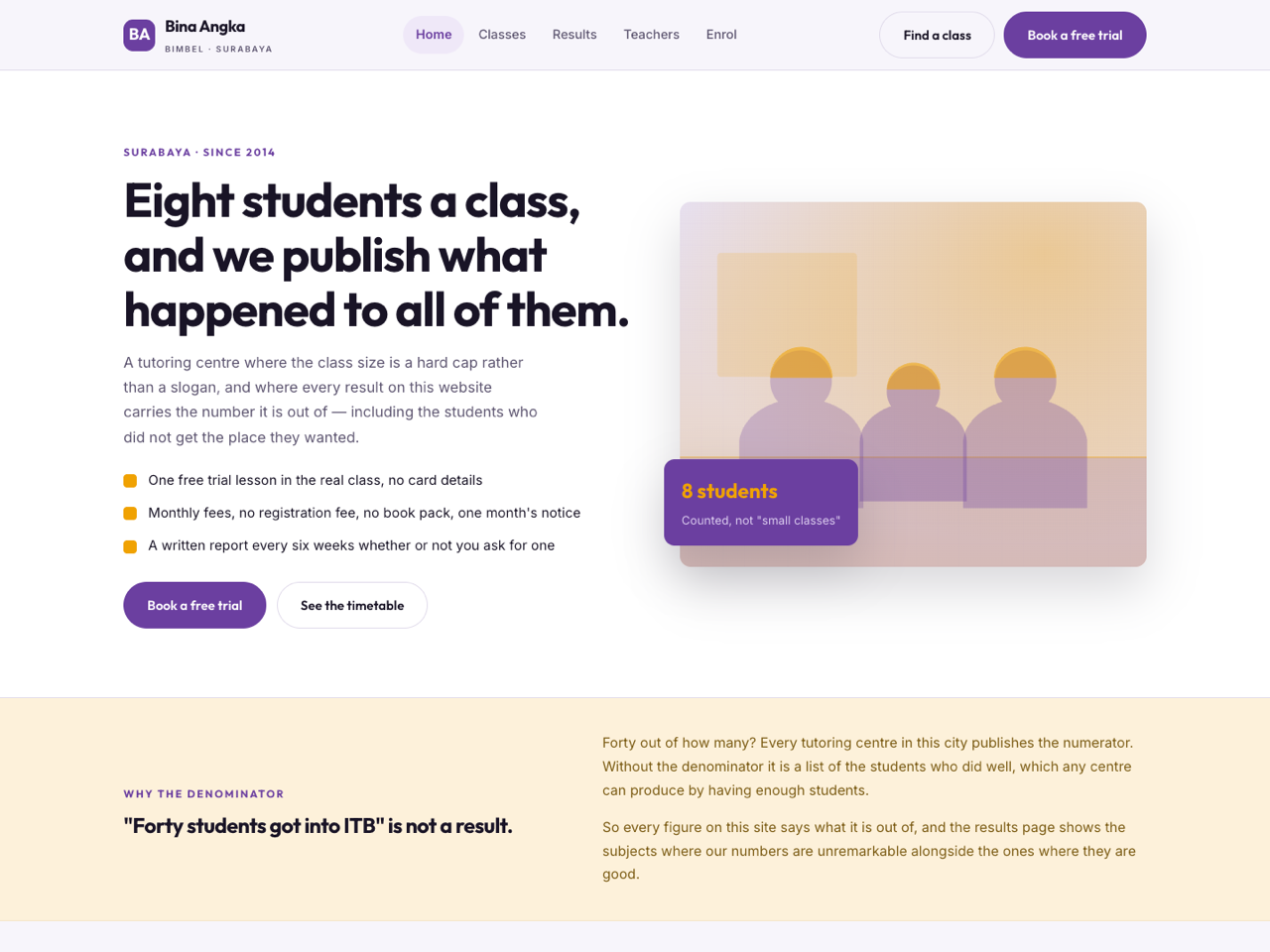
Tutoring is a five-page website for a tutoring centre that competes on one uncomfortable habit: every result is published with the denominator attached, including the students who did not get a place and the ones who left mid-year. Two working mechanisms carry it: a class finder filtering twelve classes by level, subject and day in a single pass, and result bars whose percentage and width both come from the same two numbers.
Pages included
Home — hero on the eight-student cap, an amber band explaining why "forty students got into ITB" is not a result, four cohort figures with live bars — the fourth being the twelve who did not get in — four levels with fees, a four-step joining process where the first two are free, and three quotes including a parent whose child missed out.
Classes — twelve classes with a three-facet filter (level × subject × day) applied in one pass so a later facet cannot un-hide what an earlier one hid, a live count of matching classes and remaining places, real seat numbers including two classes marked full with a waiting list, and an included/never-charged pair of lists.
Results — the whole 2026 cohort of 83 across six rows, ending with the seven students who left before the exam and stayed in the denominator; a six-row subject table whose bottom two rows are deliberately unimpressive; three things the numbers do not show, including that the centre selects a little; and the counting method written out so it can be compared with anybody else's.
Teachers — five profiles, one per subject rather than one per class, with year of qualification and what each is actually responsible for; and three arrangements that cost the business money (salaried not per-session, one subject across all levels, teachers write the reports).
Enrol — a trial-booking form asking for the school textbook and what the parent wants changed, a note that two classes are full, the entire fee list on one screen with automatic discounts, directions, and five questions including a refusal to guarantee a result.
Design and style. Purple and amber on a pale lilac, Outfit over Inter, pill buttons, rounded cards, a translucent sticky header. The shared script carries the menu, the finder, the result bars, accordions and a date guard — all vanilla and null-guarded, since it runs on every page.
Before you publish. Fees appear on the home page level cards, in every class row and in the fee list on the enrol page — three places that must agree. Seat counts live in data-seats and drive both the badge and the live "places left" total, so a class marked full must have data-seats="0". Each result bar reads data-got and data-of; the percentage and the bar width are both derived, so they cannot drift apart. The published cohort figures are the entire argument of this template and the one thing you must not invent — if you will not publish your own denominators, use a different template rather than borrowing this one's credibility. Forms use named inputs with no action attribute, so PageHub attaches the handler on publish and bookings arrive in Form Submissions with the level, subject and school attached.
Best suited to tutoring centres and exam preparation, language schools, music and art schools, coding bootcamps, driving schools and professional training providers — anywhere a parent or student is being asked to trust a claim about outcomes.
Pages included
Home — hero on the eight-student cap, an amber band explaining why "forty students got into ITB" is not a result, four cohort figures with live bars — the fourth being the twelve who did not get in — four levels with fees, a four-step joining process where the first two are free, and three quotes including a parent whose child missed out.
Classes — twelve classes with a three-facet filter (level × subject × day) applied in one pass so a later facet cannot un-hide what an earlier one hid, a live count of matching classes and remaining places, real seat numbers including two classes marked full with a waiting list, and an included/never-charged pair of lists.
Results — the whole 2026 cohort of 83 across six rows, ending with the seven students who left before the exam and stayed in the denominator; a six-row subject table whose bottom two rows are deliberately unimpressive; three things the numbers do not show, including that the centre selects a little; and the counting method written out so it can be compared with anybody else's.
Teachers — five profiles, one per subject rather than one per class, with year of qualification and what each is actually responsible for; and three arrangements that cost the business money (salaried not per-session, one subject across all levels, teachers write the reports).
Enrol — a trial-booking form asking for the school textbook and what the parent wants changed, a note that two classes are full, the entire fee list on one screen with automatic discounts, directions, and five questions including a refusal to guarantee a result.
Design and style. Purple and amber on a pale lilac, Outfit over Inter, pill buttons, rounded cards, a translucent sticky header. The shared script carries the menu, the finder, the result bars, accordions and a date guard — all vanilla and null-guarded, since it runs on every page.
Before you publish. Fees appear on the home page level cards, in every class row and in the fee list on the enrol page — three places that must agree. Seat counts live in data-seats and drive both the badge and the live "places left" total, so a class marked full must have data-seats="0". Each result bar reads data-got and data-of; the percentage and the bar width are both derived, so they cannot drift apart. The published cohort figures are the entire argument of this template and the one thing you must not invent — if you will not publish your own denominators, use a different template rather than borrowing this one's credibility. Forms use named inputs with no action attribute, so PageHub attaches the handler on publish and bookings arrive in Form Submissions with the level, subject and school attached.
Best suited to tutoring centres and exam preparation, language schools, music and art schools, coding bootcamps, driving schools and professional training providers — anywhere a parent or student is being asked to trust a claim about outcomes.
Chưa có đánh giá. Đánh giá đến từ những người thật sự đã dùng mẫu này.