
Vista previa de la plantilla
Abrir completa ↗
Pernikahan
Wedding Organizer
«Usar» abre el panel de PageHub para que empieces con esta plantilla.
- Categoría
- Pernikahan
- Tipo
- Sitio de varias páginas
- Páginas
- 5
- Tienda online
- No incluida
- Publicada
- 1 septiembre 2026
- Usada
- Nunca usada
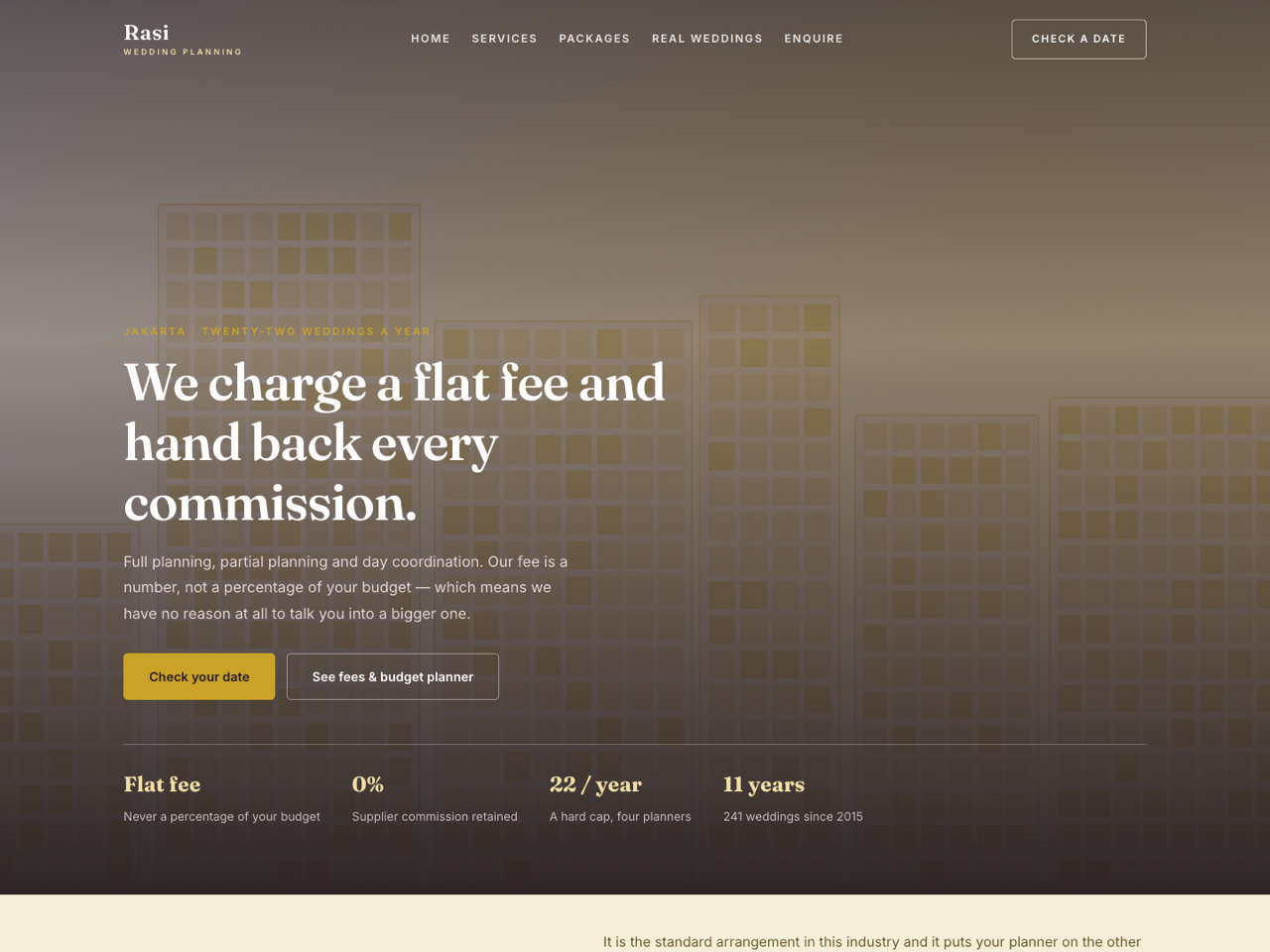
Wedding Organizer is a five-page website for a planning studio whose whole argument is a pricing model: a flat fee instead of a percentage, and every supplier commission handed back. Two working mechanisms carry it: a budget planner that divides by guest count and refuses to pretend an impossible budget is possible, and a service switcher where each service ends by naming who should not book it.
Pages included
Home — full-bleed hero over a photograph, a gold band explaining why a planner on 10% wants your budget to grow, three services with flat fees, a six-stage year that includes "the quiet part" nobody explains, four real weddings captioned with budget and guest count, six months of availability, and three couples' quotes including one about a disagreement the studio won.
Services — a three-way switcher for full, partial and day coordination, each with an inclusion list, a fee sidebar and a "do not book this if" box that sends readers to the cheaper option; an included/never-included pair of lists; four staff profiles; and a supplier table with the commission each category offers, all of it rebated.
Packages — the budget planner: total budget and guest count drive seven animated share bars, a total-per-guest and catering-per-guest reading, and a warning that appears only when the catering line falls below what the market can actually deliver — with the number of guests the same money would feed properly. Then the three flat fees, a commission register with last year's totals, and six money questions.
Real Weddings — four case studies with guest count, total spend, cost per guest and a five-line budget split, each closing with a lesson including one about a mistake the studio made. Then three patterns that hold across 241 weddings.
Enquire — a form asking for budget band and guest count before venue, a sidebar pointing budget-anxious readers to the planner first, a four-step booking sequence, studio details with access notes, and five questions.
Design and style. Dusty rose and gold on warm cream, Fraunces over Inter, small radii, a transparent header that turns solid over a dark hero. The shared script carries the menu, the budget planner, the tab switcher, accordions and a date guard — all vanilla and null-guarded, since it runs on every page.
Before you publish. The three fees appear on the home page, the services page and the packages page — change all three together. The budget split lives in data-share attributes on each row, and the catering row is marked data-floor-row so the warning reads its percentage back off the markup rather than repeating it in the script; keep that marker if you re-order the rows. The realistic catering floor is a single constant near the top of the planner and it is market-specific — set it to what your caterers actually charge, or the warning will fire at the wrong moment in both directions. Everything about the commission policy is a promise your studio has to keep; delete it rather than inherit it. Forms use named inputs with no action attribute, so PageHub attaches the handler on publish and enquiries arrive in Form Submissions with the date, guest count and budget band attached.
Best suited to wedding planners and event organisers, venue and catering coordinators, corporate event agencies, party and celebration planners, and any service billed as a fee on somebody else's budget.
Pages included
Home — full-bleed hero over a photograph, a gold band explaining why a planner on 10% wants your budget to grow, three services with flat fees, a six-stage year that includes "the quiet part" nobody explains, four real weddings captioned with budget and guest count, six months of availability, and three couples' quotes including one about a disagreement the studio won.
Services — a three-way switcher for full, partial and day coordination, each with an inclusion list, a fee sidebar and a "do not book this if" box that sends readers to the cheaper option; an included/never-included pair of lists; four staff profiles; and a supplier table with the commission each category offers, all of it rebated.
Packages — the budget planner: total budget and guest count drive seven animated share bars, a total-per-guest and catering-per-guest reading, and a warning that appears only when the catering line falls below what the market can actually deliver — with the number of guests the same money would feed properly. Then the three flat fees, a commission register with last year's totals, and six money questions.
Real Weddings — four case studies with guest count, total spend, cost per guest and a five-line budget split, each closing with a lesson including one about a mistake the studio made. Then three patterns that hold across 241 weddings.
Enquire — a form asking for budget band and guest count before venue, a sidebar pointing budget-anxious readers to the planner first, a four-step booking sequence, studio details with access notes, and five questions.
Design and style. Dusty rose and gold on warm cream, Fraunces over Inter, small radii, a transparent header that turns solid over a dark hero. The shared script carries the menu, the budget planner, the tab switcher, accordions and a date guard — all vanilla and null-guarded, since it runs on every page.
Before you publish. The three fees appear on the home page, the services page and the packages page — change all three together. The budget split lives in data-share attributes on each row, and the catering row is marked data-floor-row so the warning reads its percentage back off the markup rather than repeating it in the script; keep that marker if you re-order the rows. The realistic catering floor is a single constant near the top of the planner and it is market-specific — set it to what your caterers actually charge, or the warning will fire at the wrong moment in both directions. Everything about the commission policy is a promise your studio has to keep; delete it rather than inherit it. Forms use named inputs with no action attribute, so PageHub attaches the handler on publish and enquiries arrive in Form Submissions with the date, guest count and budget band attached.
Best suited to wedding planners and event organisers, venue and catering coordinators, corporate event agencies, party and celebration planners, and any service billed as a fee on somebody else's budget.
Aún no hay reseñas. Las reseñas vienen de quienes usaron esta plantilla de verdad.