
Xem trước mẫu
Mở toàn màn hình ↗
Chung
Product Demo Request
“Dùng” sẽ mở bảng điều khiển PageHub để bạn bắt đầu từ mẫu này.
- Danh mục
- Chung
- Loại
- Landing page
- Đăng ngày
- 1 tháng 9 2026
- Đã dùng
- Chưa từng dùng
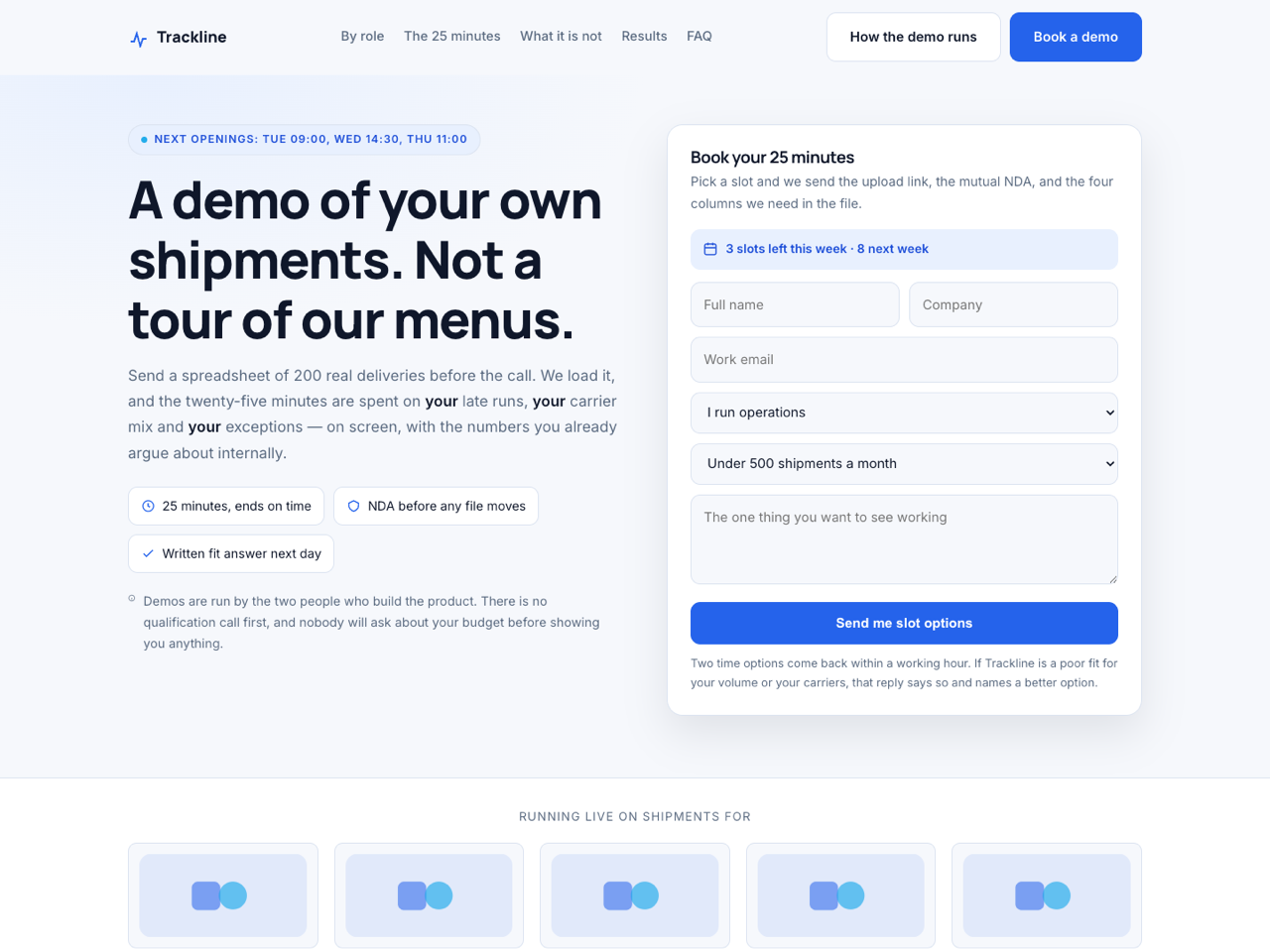
Product Demo Request is a landing page for B2B software sold by showing it. Its whole argument is that the demo runs on the buyer's own data rather than a tidy sample set — and it removes the three things buyers dread: the discovery call, the slide deck, and the follow-up sequence.
Sections, in order
Sticky navbar with anchors and a booking button.
Hero — next available slots as the scarcity line, a headline that promises the buyer's own numbers, three trust chips (length, NDA, written answer), and a booking card with role and volume selectors plus a free-text "the one thing you want to see working".
Customer logo row.
Same product, three demos — a working role switcher (Operations / Finance / IT) that changes both the copy and the screenshot, because a demo shown to everyone convinces nobody.
The 25 minutes — four timed blocks, with only the first two minutes belonging to the vendor.
What it is not — a dark band with three refusals: not a discovery call, not a deck, not the start of a cadence.
What to send first — three cards: 200 anonymised rows, the workflow you want to see, and the colleague who will say no.
Results — three customers with one headline number each, measured against their own baseline.
FAQ — six questions on sending data, deletion, pricing on the call, attendee count, recording, and being too small.
Closing booking form on a gradient card, with a WhatsApp alternative.
Design and style. Cobalt and cyan on a cool off-white, Manrope over Inter, soft radial glow behind the hero, rounded cards and one dark band for the refusals. Role switcher, FAQ accordion, scroll reveal and mobile menu are vanilla JavaScript with no libraries.
Before you publish. The role switcher is the piece to edit carefully: three panels, each needing its own screenshot and its own four bullets — a panel that repeats the others is worse than deleting the switcher. Keep the slot count identical in the hero badge, the booking card and the closing CTA, and make sure the promises in "what it is not" match how your team actually sells, because that section is a commitment. Both forms use named inputs with no action attribute, so PageHub attaches the submit handler on publish and every request lands in Form Submissions with role and volume already structured.
Best suited to B2B SaaS, logistics and operations platforms, ERP and finance tools, developer products, agencies selling a system rather than hours, and any product whose sale depends on being seen working.
Sections, in order
Sticky navbar with anchors and a booking button.
Hero — next available slots as the scarcity line, a headline that promises the buyer's own numbers, three trust chips (length, NDA, written answer), and a booking card with role and volume selectors plus a free-text "the one thing you want to see working".
Customer logo row.
Same product, three demos — a working role switcher (Operations / Finance / IT) that changes both the copy and the screenshot, because a demo shown to everyone convinces nobody.
The 25 minutes — four timed blocks, with only the first two minutes belonging to the vendor.
What it is not — a dark band with three refusals: not a discovery call, not a deck, not the start of a cadence.
What to send first — three cards: 200 anonymised rows, the workflow you want to see, and the colleague who will say no.
Results — three customers with one headline number each, measured against their own baseline.
FAQ — six questions on sending data, deletion, pricing on the call, attendee count, recording, and being too small.
Closing booking form on a gradient card, with a WhatsApp alternative.
Design and style. Cobalt and cyan on a cool off-white, Manrope over Inter, soft radial glow behind the hero, rounded cards and one dark band for the refusals. Role switcher, FAQ accordion, scroll reveal and mobile menu are vanilla JavaScript with no libraries.
Before you publish. The role switcher is the piece to edit carefully: three panels, each needing its own screenshot and its own four bullets — a panel that repeats the others is worse than deleting the switcher. Keep the slot count identical in the hero badge, the booking card and the closing CTA, and make sure the promises in "what it is not" match how your team actually sells, because that section is a commitment. Both forms use named inputs with no action attribute, so PageHub attaches the submit handler on publish and every request lands in Form Submissions with role and volume already structured.
Best suited to B2B SaaS, logistics and operations platforms, ERP and finance tools, developer products, agencies selling a system rather than hours, and any product whose sale depends on being seen working.
Chưa có đánh giá. Đánh giá đến từ những người thật sự đã dùng mẫu này.