
Vista previa de la plantilla
Abrir completa ↗
General
Home Services
«Usar» abre el panel de PageHub para que empieces con esta plantilla.
- Categoría
- General
- Tipo
- Sitio de varias páginas
- Páginas
- 5
- Tienda online
- No incluida
- Publicada
- 1 septiembre 2026
- Usada
- Nunca usada
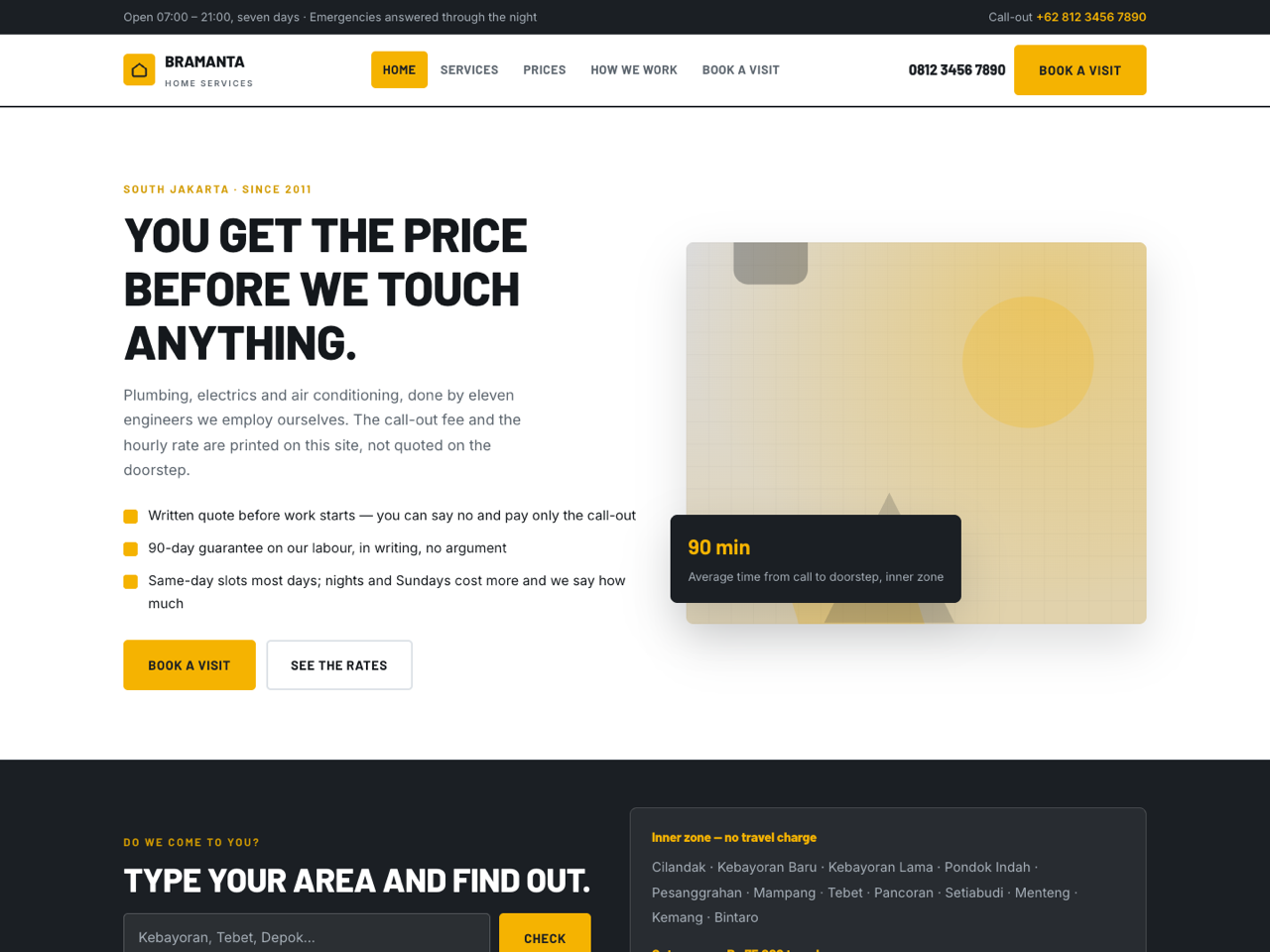
Home Services is a five-page website for a trades company — plumbing, electrics, air conditioning — built around the one thing that decides whether a stranger lets you into their house: the price is printed before anyone knocks. Two working mechanisms carry it: a service-area checker and a job estimator that computes every figure it shows.
Pages included
Home — hero stating the call-out fee policy, a dark band with the area checker (type a district, get covered / surcharge / not on the list, with the inner-zone names printed from the same array the check reads), six job cards each with a starting price, four counted figures including the second-visit rate, a four-step visit walkthrough where step three is the customer saying no, and three reviews including a four-star one about a late arrival.
Services — four alternating trade blocks with what is covered and the rate for each, a dark "what we do / what we send elsewhere" pair of lists, and a parts table showing cost price against charge price — the same figure in both columns, which is the point.
Prices — the estimator: job type, time of day and estimated hours produce call-out, hourly rate, labour and total, all derived from data attributes so no rate is typed twice; the selection is sent as a hidden field. Then the full rate card (whose evening, Sunday and night rows are the daytime rate times the estimator's own multipliers), six fixed-price jobs, a four-part guarantee including what is not covered, and six money questions.
How We Work — a seven-stage timeline from the call to the invoice, four staff profiles, three rules that cost the company money (no commission on parts, late means free call-out, the return rate is published), and last year's four figures including the jobs that ended in a "no".
Book a Visit — a booking form asking for a two-hour window and whether anyone will be in, an urgent box that sends emergencies to the telephone with the night rate stated, this week's availability, workshop details, and five booking questions.
Design and style. Charcoal and safety yellow on a cool grey, Barlow over Inter, uppercase headings, square-ish cards, a sticky solid header over a dark contact strip. The shared script carries the menu, the area checker, the estimator, accordions, count-ups and a date guard — all vanilla and null-guarded, since it runs on every page.
Before you publish. The call-out fee and hourly rates appear in the estimator's data attributes, in the rate card table, on the home page cards and in the booking sidebar — change them everywhere or the estimator will contradict the table a customer is reading beside it. The coverage lists live in two arrays at the top of script.js; the outer-zone names are also written into the markup, so edit both. The published second-visit rate, the waived call-out count and the "no" count are commitments to keep publishing, not decoration — if you will not update them monthly, remove them rather than let them go stale. Forms use named inputs with no action attribute, so PageHub attaches the handler on publish and requests arrive in Form Submissions with the trade, date, window and estimate attached.
Best suited to plumbers, electricians, air-conditioning and appliance engineers, pest control, cleaning and gardening firms, locksmiths and handyman services — any trade where the customer's real hesitation is not knowing what the visit will cost.
Pages included
Home — hero stating the call-out fee policy, a dark band with the area checker (type a district, get covered / surcharge / not on the list, with the inner-zone names printed from the same array the check reads), six job cards each with a starting price, four counted figures including the second-visit rate, a four-step visit walkthrough where step three is the customer saying no, and three reviews including a four-star one about a late arrival.
Services — four alternating trade blocks with what is covered and the rate for each, a dark "what we do / what we send elsewhere" pair of lists, and a parts table showing cost price against charge price — the same figure in both columns, which is the point.
Prices — the estimator: job type, time of day and estimated hours produce call-out, hourly rate, labour and total, all derived from data attributes so no rate is typed twice; the selection is sent as a hidden field. Then the full rate card (whose evening, Sunday and night rows are the daytime rate times the estimator's own multipliers), six fixed-price jobs, a four-part guarantee including what is not covered, and six money questions.
How We Work — a seven-stage timeline from the call to the invoice, four staff profiles, three rules that cost the company money (no commission on parts, late means free call-out, the return rate is published), and last year's four figures including the jobs that ended in a "no".
Book a Visit — a booking form asking for a two-hour window and whether anyone will be in, an urgent box that sends emergencies to the telephone with the night rate stated, this week's availability, workshop details, and five booking questions.
Design and style. Charcoal and safety yellow on a cool grey, Barlow over Inter, uppercase headings, square-ish cards, a sticky solid header over a dark contact strip. The shared script carries the menu, the area checker, the estimator, accordions, count-ups and a date guard — all vanilla and null-guarded, since it runs on every page.
Before you publish. The call-out fee and hourly rates appear in the estimator's data attributes, in the rate card table, on the home page cards and in the booking sidebar — change them everywhere or the estimator will contradict the table a customer is reading beside it. The coverage lists live in two arrays at the top of script.js; the outer-zone names are also written into the markup, so edit both. The published second-visit rate, the waived call-out count and the "no" count are commitments to keep publishing, not decoration — if you will not update them monthly, remove them rather than let them go stale. Forms use named inputs with no action attribute, so PageHub attaches the handler on publish and requests arrive in Form Submissions with the trade, date, window and estimate attached.
Best suited to plumbers, electricians, air-conditioning and appliance engineers, pest control, cleaning and gardening firms, locksmiths and handyman services — any trade where the customer's real hesitation is not knowing what the visit will cost.
Aún no hay reseñas. Las reseñas vienen de quienes usaron esta plantilla de verdad.