
Pratonton templat
Buka penuh ↗
Umum
Car Workshop
"Guna" membuka papan pemuka PageHub supaya anda boleh bermula daripada templat ini.
- Kategori
- Umum
- Jenis
- Laman web berbilang halaman
- Halaman
- 5
- Kedai dalam talian
- Tidak disertakan
- Diterbitkan
- 1 September 2026
- Digunakan
- Tidak pernah digunakan
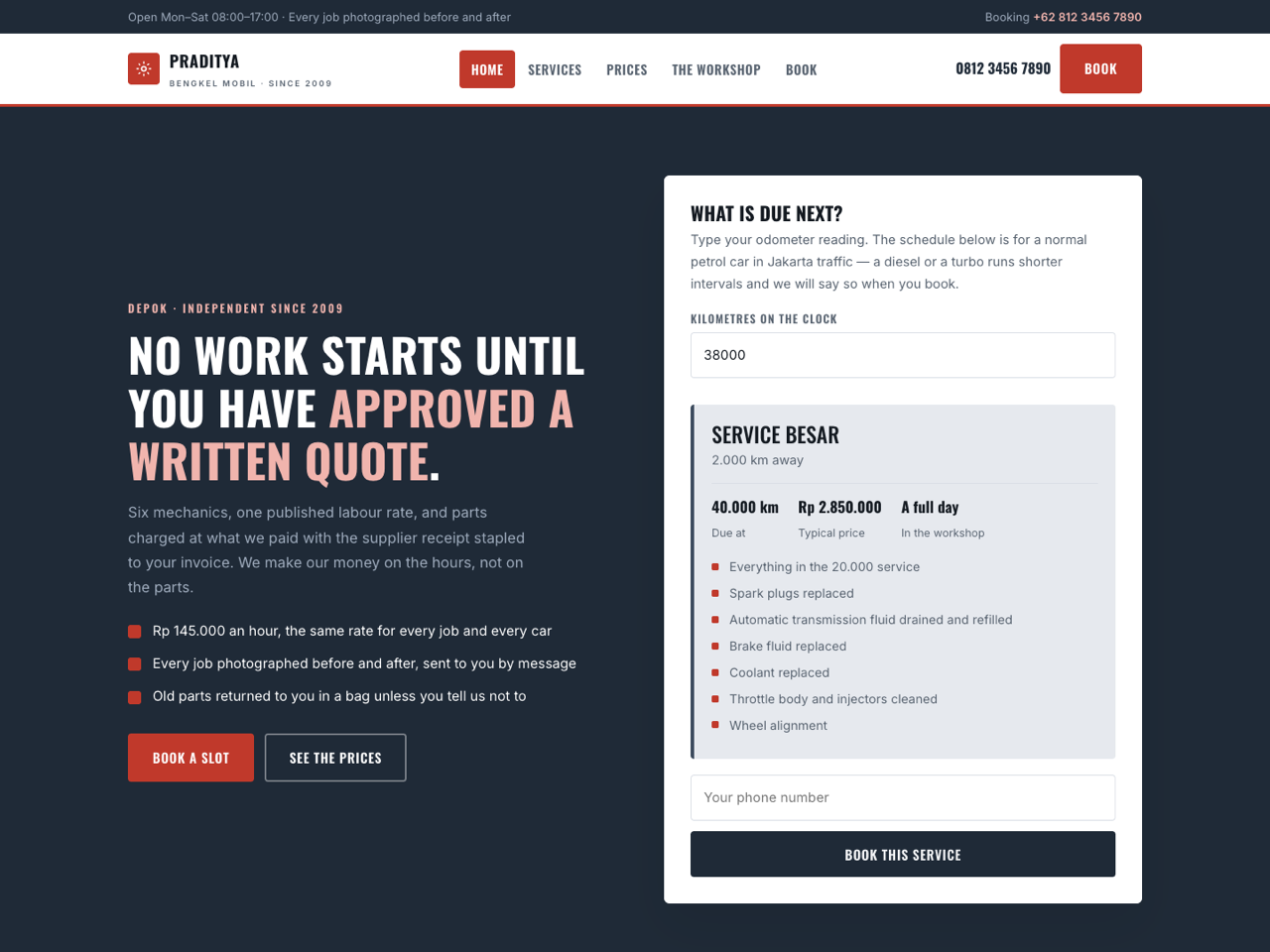
Car Workshop is a five-page website for an independent garage competing on the one thing customers cannot verify for themselves: whether the work was needed. Two working mechanisms carry it: a service-interval lookup that takes an odometer reading and tells you which service is due, at what kilometre and for how much, and a parts table showing cost price beside charge price — the same figure twice, which is the point.
Pages included
Home — dark hero built on "no work starts until you have approved a written quote", beside the lookup: type your kilometres and the matching row in the four-service schedule below highlights itself, with what it includes, what it costs and how long the car is in. Then four rules that each cost the workshop money, four counted figures including the return-visit rate, and three reviews including a three-star one about a late car.
Services — five detailed blocks (servicing, brakes, engine diagnosis, air conditioning, pre-purchase inspection), each with a price sidebar and a red-lined "found out too late" box that says the uncomfortable thing — brake pads at 4 mm are not urgent, a yearly AC regas means a leak. Then a scope list including what gets referred out, and a table of which makes the workshop is quick on and which will sit waiting for parts.
Prices — the three numbers that explain every invoice (hourly rate, diagnosis fee, zero markup), an eight-row parts table with genuine and aftermarket side by side and the fitting time for each, fourteen fixed prices, a four-part guarantee including what happens when the customer supplied the part, and six money questions.
The Workshop — three named staff, an equipment list paired with an honest "what we do not have" column, and last year's four figures including the one that gets worse when standards slip.
Book — a form asking for the symptom and the odometer, a red "do not drive it if…" box, this week's bay availability, a four-stage job walkthrough where each stage is a customer decision, directions, and five questions.
Design and style. Graphite and workshop red on cool grey, condensed Oswald over Inter, square corners, a solid sticky header with a red rule under it. The shared script carries the menu, the interval lookup, accordions, count-ups and a date guard — all vanilla and null-guarded, since it runs on every page.
Before you publish. The service schedule lives in the page as data-interval rows, not in the JavaScript — deliberately, because a workshop changes its intervals and prices far more often than its code, and the person editing the table should not have to open a .js file. Each row carries its own interval, name, price, duration and inclusion list; the lookup reads all of it back. The four service prices also appear on the prices page and in the services sidebar, so change them in all three. The labour rate appears in the footer, on the prices page and in two service sidebars. The published return-visit rate, the "parts at cost" promise and the returned old parts are commitments your workshop has to actually keep — they are the whole argument of this template, and a garage that does not keep them is better off with a different one. Forms use named inputs with no action attribute, so PageHub attaches the handler on publish and bookings arrive in Form Submissions with the car, odometer and symptom attached.
Best suited to car and motorcycle workshops, tyre and exhaust centres, body shops, mobile mechanics, boat and machinery servicing — any repair trade where the customer's real question is whether they are being told the truth.
Pages included
Home — dark hero built on "no work starts until you have approved a written quote", beside the lookup: type your kilometres and the matching row in the four-service schedule below highlights itself, with what it includes, what it costs and how long the car is in. Then four rules that each cost the workshop money, four counted figures including the return-visit rate, and three reviews including a three-star one about a late car.
Services — five detailed blocks (servicing, brakes, engine diagnosis, air conditioning, pre-purchase inspection), each with a price sidebar and a red-lined "found out too late" box that says the uncomfortable thing — brake pads at 4 mm are not urgent, a yearly AC regas means a leak. Then a scope list including what gets referred out, and a table of which makes the workshop is quick on and which will sit waiting for parts.
Prices — the three numbers that explain every invoice (hourly rate, diagnosis fee, zero markup), an eight-row parts table with genuine and aftermarket side by side and the fitting time for each, fourteen fixed prices, a four-part guarantee including what happens when the customer supplied the part, and six money questions.
The Workshop — three named staff, an equipment list paired with an honest "what we do not have" column, and last year's four figures including the one that gets worse when standards slip.
Book — a form asking for the symptom and the odometer, a red "do not drive it if…" box, this week's bay availability, a four-stage job walkthrough where each stage is a customer decision, directions, and five questions.
Design and style. Graphite and workshop red on cool grey, condensed Oswald over Inter, square corners, a solid sticky header with a red rule under it. The shared script carries the menu, the interval lookup, accordions, count-ups and a date guard — all vanilla and null-guarded, since it runs on every page.
Before you publish. The service schedule lives in the page as data-interval rows, not in the JavaScript — deliberately, because a workshop changes its intervals and prices far more often than its code, and the person editing the table should not have to open a .js file. Each row carries its own interval, name, price, duration and inclusion list; the lookup reads all of it back. The four service prices also appear on the prices page and in the services sidebar, so change them in all three. The labour rate appears in the footer, on the prices page and in two service sidebars. The published return-visit rate, the "parts at cost" promise and the returned old parts are commitments your workshop has to actually keep — they are the whole argument of this template, and a garage that does not keep them is better off with a different one. Forms use named inputs with no action attribute, so PageHub attaches the handler on publish and bookings arrive in Form Submissions with the car, odometer and symptom attached.
Best suited to car and motorcycle workshops, tyre and exhaust centres, body shops, mobile mechanics, boat and machinery servicing — any repair trade where the customer's real question is whether they are being told the truth.
Belum ada ulasan. Ulasan datang daripada orang yang benar-benar menggunakan templat ini.