
Aperçu du modèle
Ouvrir en plein écran ↗
Général
Startup / SaaS
« Utiliser » ouvre le tableau de bord PageHub pour démarrer à partir de ce modèle.
- Catégorie
- Général
- Type
- Site multipage
- Pages
- 5
- Boutique en ligne
- Non incluse
- Publié
- 1 septembre 2026
- Utilisé
- Jamais utilisé
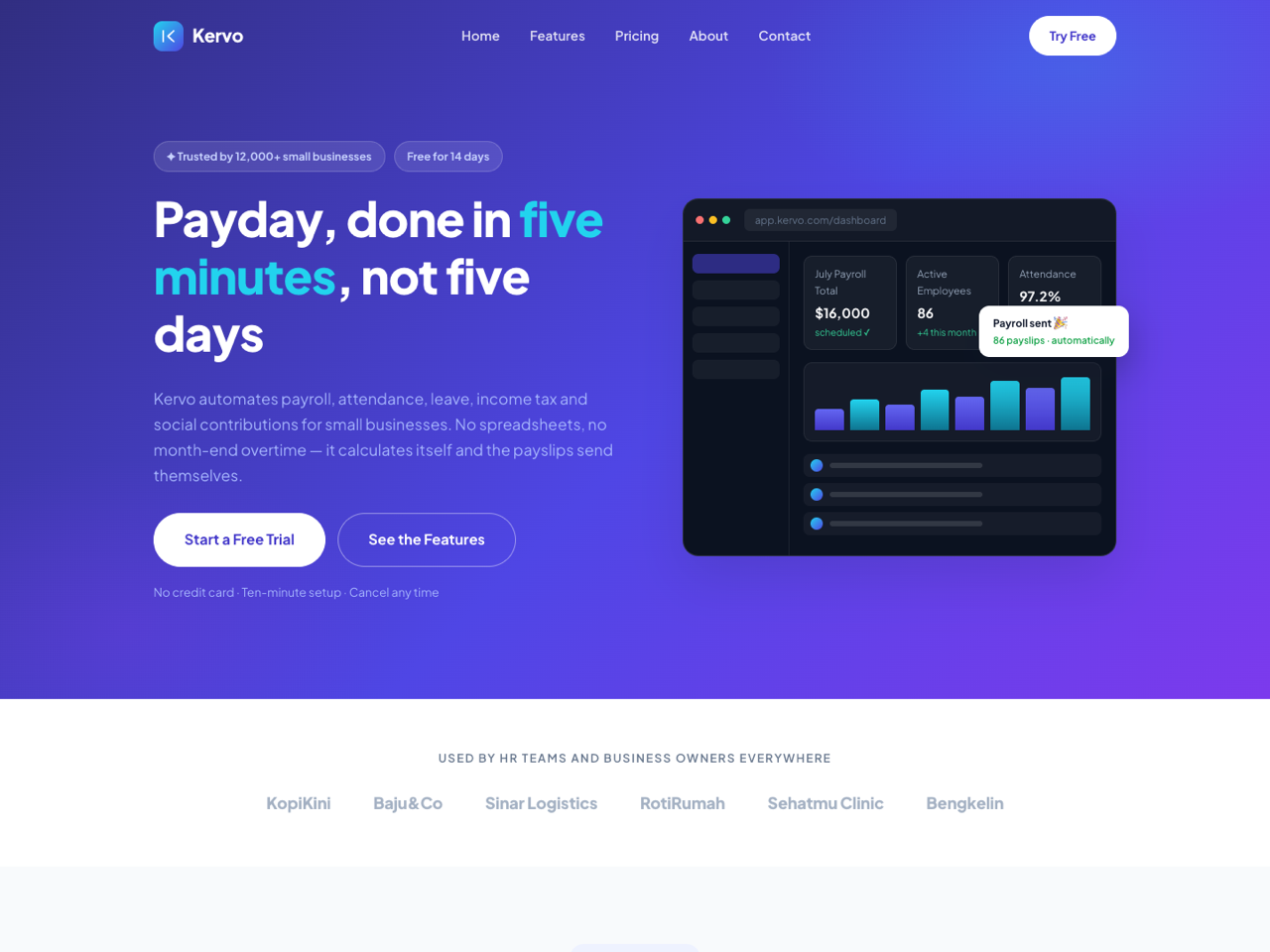
Startup / SaaS is a five-page website for a software company selling a subscription. It is the full B2B case: what the product does, module by module, what it costs per seat, who built it, and how to get a demo — with a security section, because payroll data is the example and trust is the obstacle.
Pages included
Home — a hero with a detailed product dashboard mockup built entirely in HTML and CSS (statistics, chart, notification cards), a client logo strip, six feature cards, a three-step adoption path, three testimonials, and a trial CTA.
Features — four modules, each with its own working interface mockup: a payslip breakdown down to the last line item, a clock-in screen, a leave approval list, and a bar chart of cost by department. Then eight integration tiles and a three-card security section.
Pricing — three tiers with a monthly/annual toggle, per-seat pricing, feature lists that also show what a tier does not include, a full comparison table across three feature groups, and a six-question pricing FAQ answering the ones that decide a purchase.
About — the mission, four statistics, a founder quote, the origin story told as a real problem rather than a vision statement, four values with the consequence of each, four team profiles, and open roles.
Contact — a demo request form with company name and headcount range, four direct contact cards with response times, support hours, and a four-question pre-demo FAQ.
Design and style. Indigo #4f46e5 on white with slate text, Plus Jakarta Sans, and interface mockups drawn in markup rather than pasted as screenshots — which means you edit them like any other content instead of reopening a design file. Header mode is overlay-light. The pricing toggle, the FAQ accordions, the mobile menu and the counters are vanilla JavaScript.
Before you publish. Update the three tiers and their annual equivalents together, and keep the comparison table consistent with the pricing cards — a buyer who finds a contradiction between them stops reading. Replace the mockup contents with your own product's, and the security claims with what you actually do.
Best suited to SaaS companies, internal tools being commercialised, fintech and HR products, developer tools, agencies productising a service — any subscription software that must justify a per-seat price.
Pages included
Home — a hero with a detailed product dashboard mockup built entirely in HTML and CSS (statistics, chart, notification cards), a client logo strip, six feature cards, a three-step adoption path, three testimonials, and a trial CTA.
Features — four modules, each with its own working interface mockup: a payslip breakdown down to the last line item, a clock-in screen, a leave approval list, and a bar chart of cost by department. Then eight integration tiles and a three-card security section.
Pricing — three tiers with a monthly/annual toggle, per-seat pricing, feature lists that also show what a tier does not include, a full comparison table across three feature groups, and a six-question pricing FAQ answering the ones that decide a purchase.
About — the mission, four statistics, a founder quote, the origin story told as a real problem rather than a vision statement, four values with the consequence of each, four team profiles, and open roles.
Contact — a demo request form with company name and headcount range, four direct contact cards with response times, support hours, and a four-question pre-demo FAQ.
Design and style. Indigo #4f46e5 on white with slate text, Plus Jakarta Sans, and interface mockups drawn in markup rather than pasted as screenshots — which means you edit them like any other content instead of reopening a design file. Header mode is overlay-light. The pricing toggle, the FAQ accordions, the mobile menu and the counters are vanilla JavaScript.
Before you publish. Update the three tiers and their annual equivalents together, and keep the comparison table consistent with the pricing cards — a buyer who finds a contradiction between them stops reading. Replace the mockup contents with your own product's, and the security claims with what you actually do.
Best suited to SaaS companies, internal tools being commercialised, fintech and HR products, developer tools, agencies productising a service — any subscription software that must justify a per-seat price.
Aucun avis pour l'instant. Les avis viennent de ceux qui ont réellement utilisé ce modèle.