
Aperçu du modèle
Ouvrir en plein écran ↗
Hukum & Notaris
Law Firm
« Utiliser » ouvre le tableau de bord PageHub pour démarrer à partir de ce modèle.
- Catégorie
- Hukum & Notaris
- Type
- Site multipage
- Pages
- 5
- Boutique en ligne
- Non incluse
- Publié
- 1 septembre 2026
- Utilisé
- Jamais utilisé
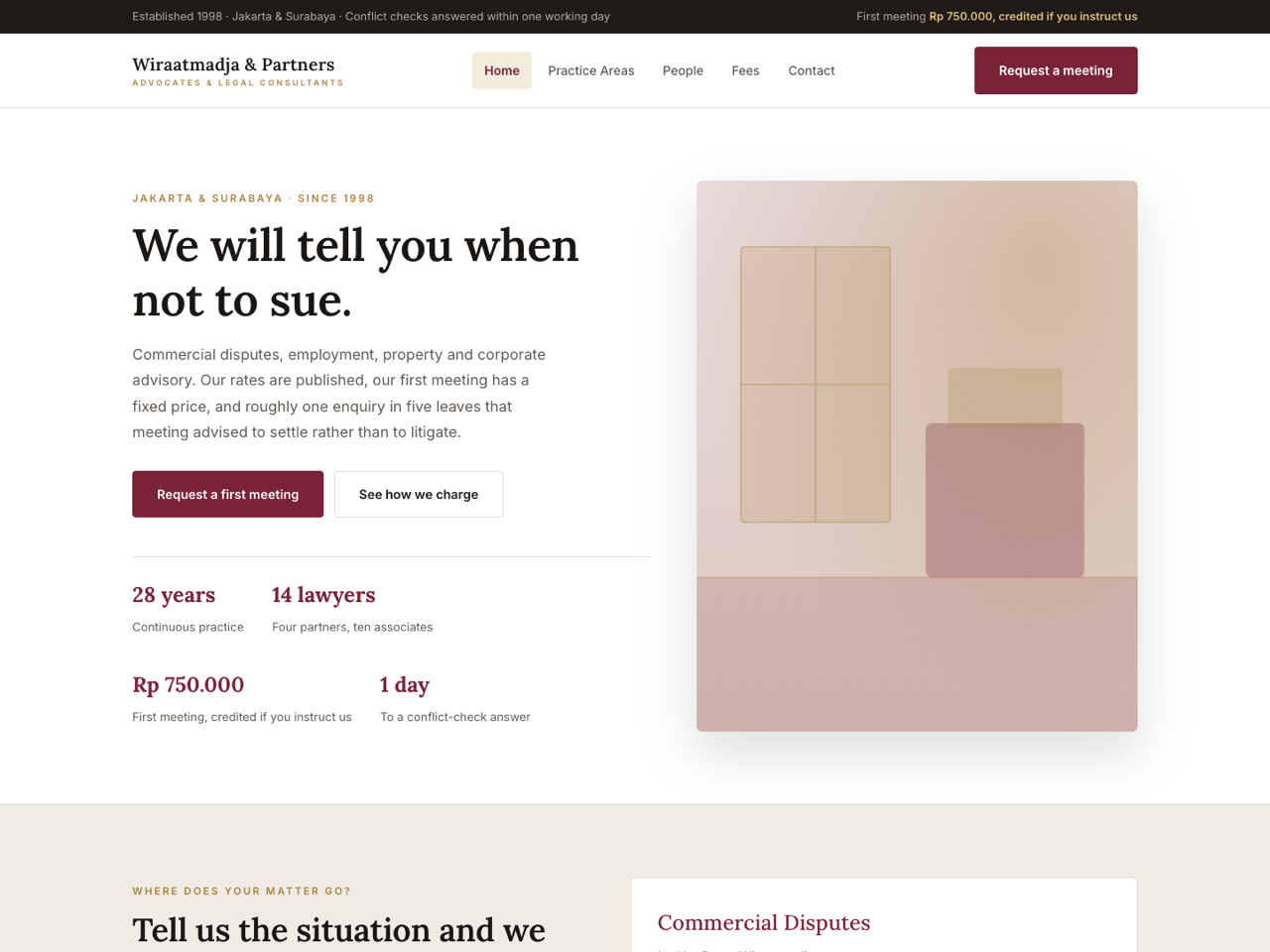
Law Firm is a five-page website for a practice that competes by publishing what it charges. Two working mechanisms carry it: a matter triage on the home page that turns "what has happened to me" into a department, a timeline, a fee basis and a list of documents to bring; and a fee-model switcher that explains all four ways the firm bills, each with a fully worked example that adds up.
Pages included
Home — a hero built on the line "we will tell you when not to sue", the triage selector (six situations, each carrying its own practice area, lead partner, duration, fee basis and what-to-bring list in data attributes so nothing is written twice), six practice-area cards, a dark band of four things most firms leave clients to discover later, a four-stage engagement process, and five anonymised recent matters — including the two that were lost.
Practice Areas — six long blocks, each with a sidebar of duration, fee basis and a fixed price, and each ending with a "what clients wish they had known" box that says the uncomfortable thing about that area. Then a two-column list of what the firm refers out, and why it takes no referral fee.
People — four partner profiles with year of call, education, languages and hourly rate; four associates; three arrangements about how the firm is run (no billing targets, the named lawyer does the work, published pro bono hours); and last year's four figures, including the meetings that ended in advice not to proceed.
Fees — the four-model switcher (hourly, fixed, fixed-per-phase, retainer), each with a worked example whose lines multiply out correctly against the rate card two sections below; the full hourly rate table; fourteen fixed prices; and a dark band naming four practices the firm does not have — no contingency, no referral fees, no success uplift, no surprise invoices.
Contact — an enquiry form that asks for the other side's name because that is what a conflict check needs, a warning box telling people not to send documents yet, both offices with access notes, a four-step "before we can act" sequence, and five questions.
Design and style. Oxblood and brass on warm stone, Lora over Inter, small radii, a sticky header above a dark utility strip. The shared script carries the menu, the triage, the tab switchers, accordions and a date guard — all vanilla and null-guarded, since it runs on every page.
Before you publish. Fee figures appear in three places that must agree: the triage's data attributes, the fixed-price list, and the worked examples on the fees page — whose arithmetic is derived from the hourly rate table, so changing a rate means re-doing those sums. Every claim of professional conduct here (no referral fees, no billing targets, pro bono hours, the published rate of matters declined) is a commitment your firm has to actually keep; delete what is not true rather than inheriting someone else's ethics page. The disclaimer in the footer and the conflict-check warning on the contact page are there for a reason — have your own regulator's wording checked before replacing them. Forms use named inputs with no action attribute, so PageHub attaches the handler on publish and enquiries arrive in Form Submissions with the practice area, counterparty and deadline attached.
Best suited to law firms and sole advocates, notaries, tax and accountancy practices, patent and trademark agents, and consulting practices that bill by the hour — any professional service where the client's real hesitation is not knowing what the first conversation will cost.
Pages included
Home — a hero built on the line "we will tell you when not to sue", the triage selector (six situations, each carrying its own practice area, lead partner, duration, fee basis and what-to-bring list in data attributes so nothing is written twice), six practice-area cards, a dark band of four things most firms leave clients to discover later, a four-stage engagement process, and five anonymised recent matters — including the two that were lost.
Practice Areas — six long blocks, each with a sidebar of duration, fee basis and a fixed price, and each ending with a "what clients wish they had known" box that says the uncomfortable thing about that area. Then a two-column list of what the firm refers out, and why it takes no referral fee.
People — four partner profiles with year of call, education, languages and hourly rate; four associates; three arrangements about how the firm is run (no billing targets, the named lawyer does the work, published pro bono hours); and last year's four figures, including the meetings that ended in advice not to proceed.
Fees — the four-model switcher (hourly, fixed, fixed-per-phase, retainer), each with a worked example whose lines multiply out correctly against the rate card two sections below; the full hourly rate table; fourteen fixed prices; and a dark band naming four practices the firm does not have — no contingency, no referral fees, no success uplift, no surprise invoices.
Contact — an enquiry form that asks for the other side's name because that is what a conflict check needs, a warning box telling people not to send documents yet, both offices with access notes, a four-step "before we can act" sequence, and five questions.
Design and style. Oxblood and brass on warm stone, Lora over Inter, small radii, a sticky header above a dark utility strip. The shared script carries the menu, the triage, the tab switchers, accordions and a date guard — all vanilla and null-guarded, since it runs on every page.
Before you publish. Fee figures appear in three places that must agree: the triage's data attributes, the fixed-price list, and the worked examples on the fees page — whose arithmetic is derived from the hourly rate table, so changing a rate means re-doing those sums. Every claim of professional conduct here (no referral fees, no billing targets, pro bono hours, the published rate of matters declined) is a commitment your firm has to actually keep; delete what is not true rather than inheriting someone else's ethics page. The disclaimer in the footer and the conflict-check warning on the contact page are there for a reason — have your own regulator's wording checked before replacing them. Forms use named inputs with no action attribute, so PageHub attaches the handler on publish and enquiries arrive in Form Submissions with the practice area, counterparty and deadline attached.
Best suited to law firms and sole advocates, notaries, tax and accountancy practices, patent and trademark agents, and consulting practices that bill by the hour — any professional service where the client's real hesitation is not knowing what the first conversation will cost.
Aucun avis pour l'instant. Les avis viennent de ceux qui ont réellement utilisé ce modèle.