
Vista previa de la plantilla
Abrir completa ↗
Listing Properti
Housing Cluster
«Usar» abre el panel de PageHub para que empieces con esta plantilla.
- Categoría
- Listing Properti
- Tipo
- Landing page
- Publicada
- 1 septiembre 2026
- Usada
- Nunca usada
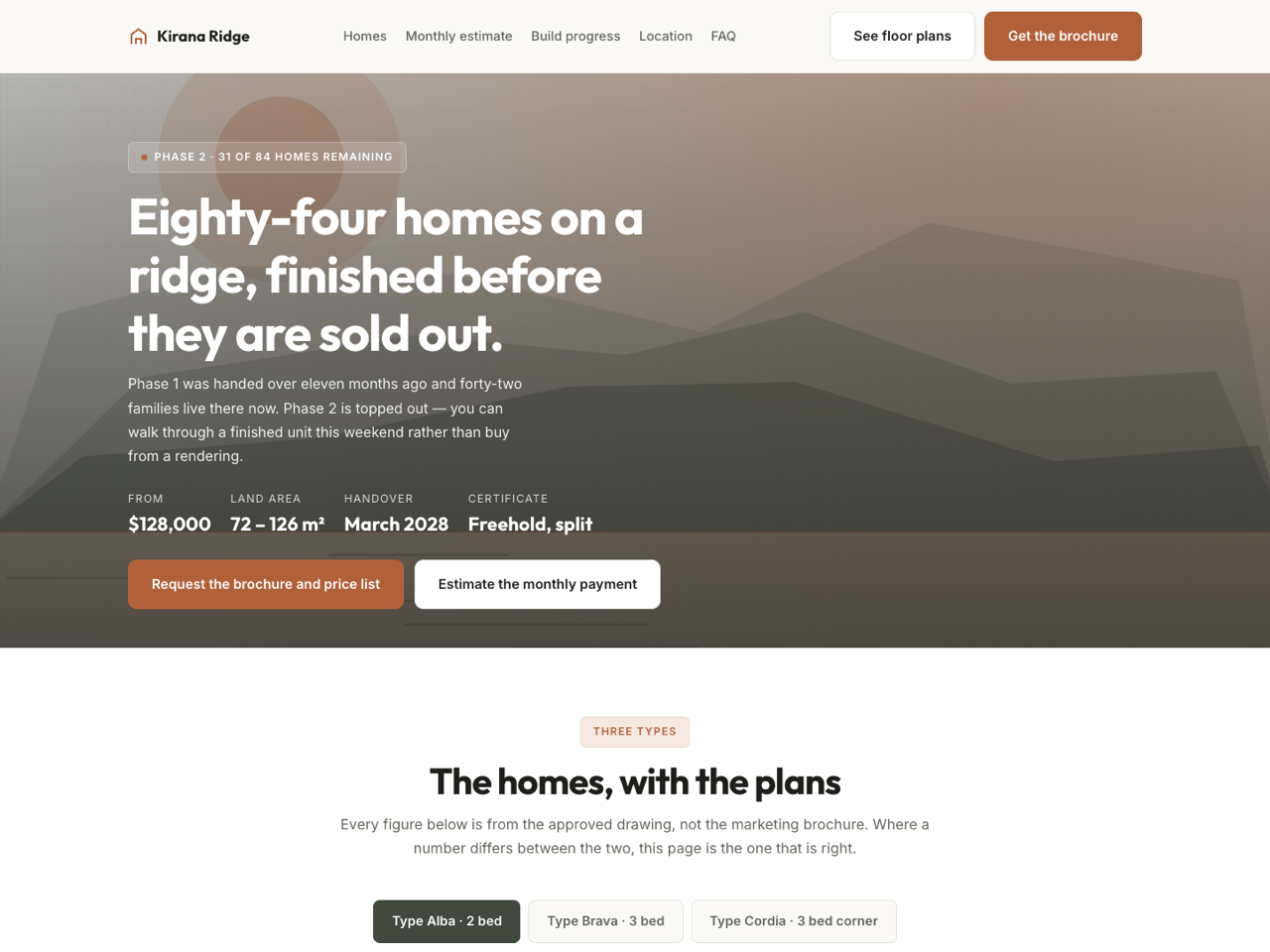
Housing Cluster is a landing page for a residential development selling off-plan or nearly finished. Buyers here are risking the largest sum of their lives on a building that may not exist yet, so the page is built around verifiable things: published build progress including the block that is behind, the escrow and certificate position, itemised fees, and a mortgage estimate they can run themselves.
Sections, in order
Sticky navbar with anchors and a brochure button.
Full-bleed hero — remaining units badge, four fact tiles (price from, land area, handover, certificate type), and the fact that a previous phase is already occupied.
Home types — a working three-tab switcher, each with a floor plan image, an availability chip, a price and a specification table taken from the approved drawing.
Monthly estimate — a working mortgage calculator with sliders for price, deposit percentage, term and rate, returning the loan amount, total interest, total repaid and the monthly instalment. It labels itself an estimate rather than an approval, and shows total interest so a longer term is not read as simply cheaper.
What the price includes — three cards: standard inclusions, the itemised exclusions, and the 6–8% of fees on top, stated as a number rather than "plus fees".
Build progress — a dark band with a bar per block, one of which is behind schedule with the reason and the remedy offered to those buyers.
Location — driven journey times at 07:30 on a weekday, beside a map.
Gallery — photographs of the completed phase rather than renderings.
FAQ — six buyer questions: escrow if the build stalls, whether the certificate is split, using your own bank, maintenance fees, layout changes, and the booking fee refund rule.
Brochure request — form with unit type, payment method and a "send the brochure only" option.
Design and style. Grounded and unglamorous: olive-slate and terracotta on warm off-white, Outfit over Inter, floor plans given real space, a dark progress band. Unit switcher, mortgage calculator, FAQ accordion, scroll reveal and mobile menu are vanilla JavaScript.
Before you publish. The calculator is an estimate and must keep saying so — deleting that line turns a helpful tool into an implied approval, and a buyer who budgets from it and is then quoted 2% higher will blame the page. Replace every specification from your own approved drawings, keep the remaining-unit counts consistent between the hero, the three tabs and the closing CTA, and keep at least one honest item in the progress section; a project where every block is on schedule reads as marketing rather than reporting. The form uses named inputs with no action attribute, so PageHub attaches the handler on publish and each request arrives in Form Submissions with unit type and payment method attached.
Best suited to housing clusters and estates, apartment launches, plotted land sales, shophouse and commercial units, and any property sold before completion where trust is the actual obstacle.
Sections, in order
Sticky navbar with anchors and a brochure button.
Full-bleed hero — remaining units badge, four fact tiles (price from, land area, handover, certificate type), and the fact that a previous phase is already occupied.
Home types — a working three-tab switcher, each with a floor plan image, an availability chip, a price and a specification table taken from the approved drawing.
Monthly estimate — a working mortgage calculator with sliders for price, deposit percentage, term and rate, returning the loan amount, total interest, total repaid and the monthly instalment. It labels itself an estimate rather than an approval, and shows total interest so a longer term is not read as simply cheaper.
What the price includes — three cards: standard inclusions, the itemised exclusions, and the 6–8% of fees on top, stated as a number rather than "plus fees".
Build progress — a dark band with a bar per block, one of which is behind schedule with the reason and the remedy offered to those buyers.
Location — driven journey times at 07:30 on a weekday, beside a map.
Gallery — photographs of the completed phase rather than renderings.
FAQ — six buyer questions: escrow if the build stalls, whether the certificate is split, using your own bank, maintenance fees, layout changes, and the booking fee refund rule.
Brochure request — form with unit type, payment method and a "send the brochure only" option.
Design and style. Grounded and unglamorous: olive-slate and terracotta on warm off-white, Outfit over Inter, floor plans given real space, a dark progress band. Unit switcher, mortgage calculator, FAQ accordion, scroll reveal and mobile menu are vanilla JavaScript.
Before you publish. The calculator is an estimate and must keep saying so — deleting that line turns a helpful tool into an implied approval, and a buyer who budgets from it and is then quoted 2% higher will blame the page. Replace every specification from your own approved drawings, keep the remaining-unit counts consistent between the hero, the three tabs and the closing CTA, and keep at least one honest item in the progress section; a project where every block is on schedule reads as marketing rather than reporting. The form uses named inputs with no action attribute, so PageHub attaches the handler on publish and each request arrives in Form Submissions with unit type and payment method attached.
Best suited to housing clusters and estates, apartment launches, plotted land sales, shophouse and commercial units, and any property sold before completion where trust is the actual obstacle.
Aún no hay reseñas. Las reseñas vienen de quienes usaron esta plantilla de verdad.