
Aperçu du modèle
Ouvrir en plein écran ↗
Général
Catering
« Utiliser » ouvre le tableau de bord PageHub pour démarrer à partir de ce modèle.
- Catégorie
- Général
- Type
- Site multipage
- Pages
- 5
- Boutique en ligne
- Non incluse
- Publié
- 1 septembre 2026
- Utilisé
- Jamais utilisé
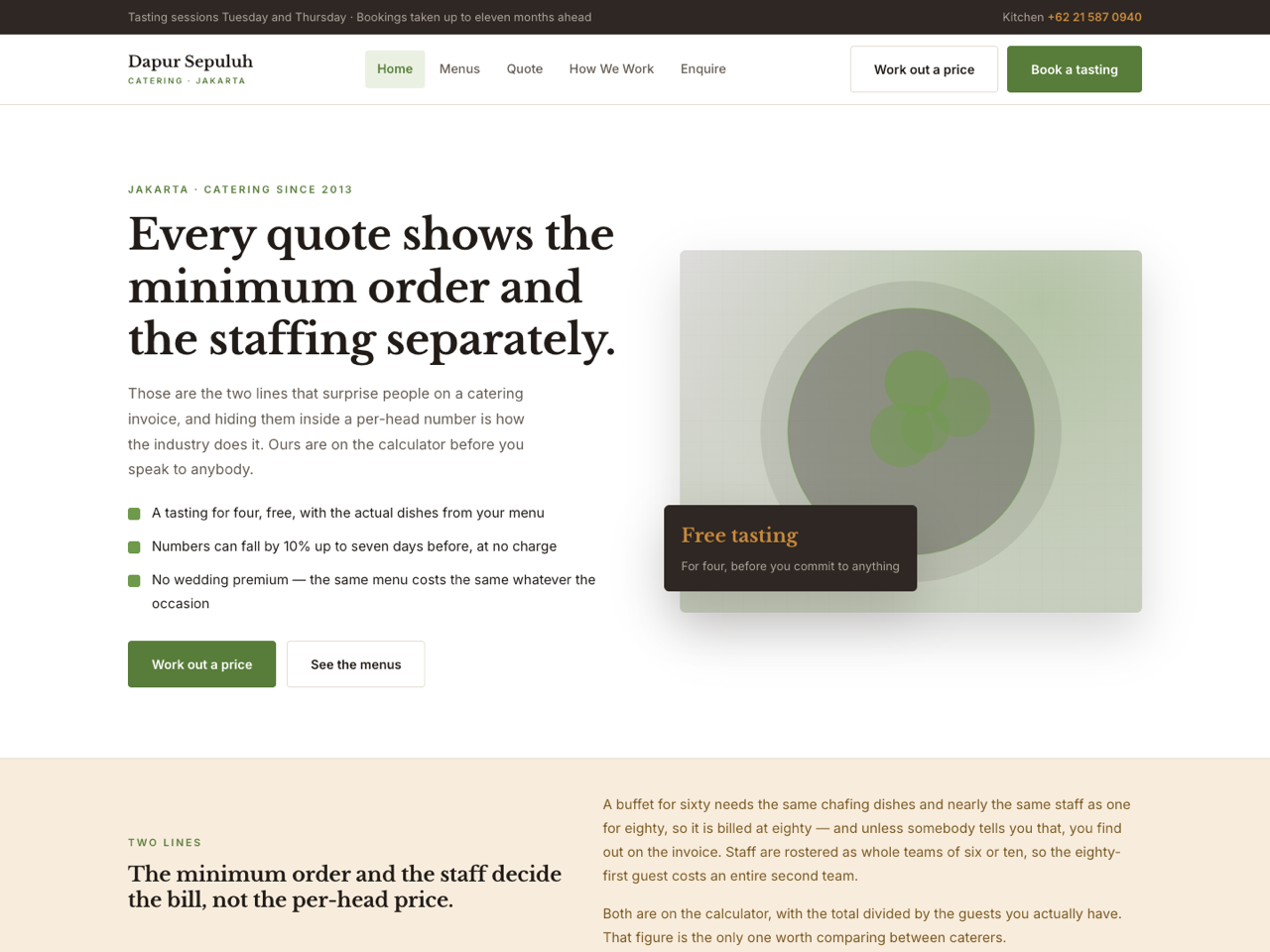
Catering is a five-page website for a catering kitchen built around the two lines that surprise people on a catering invoice and that a per-head price is designed to hide: the minimum order and the staffing. The working mechanism is a quote calculator that shows both separately, bills you for the minimum when your guest count is below it and says so, and prints what you are really paying per guest.
Pages included
Home — hero on the two hidden lines, an amber band explaining why a buffet for sixty is billed at eighty, four menus with their minimums, a six-entry timeline of the day from the 03:30 market run, four figures including a capacity cap of four events a day, and three client quotes including one about a mistake the kitchen fixed unasked.
Menus — a four-way switcher writing out every dish rather than "a selection of Indonesian favourites", each with a sidebar of price, minimum, notice period and a "choose something else if" box that sends under-minimum bookings to a cheaper menu. Then dietary handling as two lists — what is done properly and what the caterer needs from you — and a named supplier table.
Quote — the calculator: guests, menu, service level and four extras produce billed guests, per-head, food subtotal, serving teams (one per eighty, rounded up), staffing cost and a total — plus the total divided by your actual guests, which is the only figure comparable between caterers. A warning appears when you are under the minimum, naming how many people you are paying for who will not eat.
How We Work — a seven-step timeline from enquiry to invoice, three rules that cost bookings (four events a day, staff employed not hired in, quoting people down to a cheaper menu), and a food-safety section with a "what we will not do" column including refusing to cook the day before.
Enquire — a tasting-booking form that asks for the venue early because some charge caterers to come in, a hand-updated six-month availability strip, kitchen details including an open invitation to inspect it, and five questions.
Design and style. Warm brown and herb green on cream, Libre Baskerville over Inter, small radii, a solid sticky header above a dark strip. The shared script carries the menu, the calculator, tab switchers, accordions and a date guard — all vanilla and null-guarded, since it runs on every page.
Before you publish. Menu prices, minimums and service uplifts live in data-head, data-min and data-add on the calculator's radios, and the same numbers appear on the home page cards, the menus page sidebars and the rate table — four places that must agree. Staffing lives in data-staff and data-teamcost, and the one-team-per-eighty divisor is a constant in the script; change it and the rate table's staffing rows change with it. The four-events-a-day cap, the retained samples, the temperature logs and the halal certification are claims a customer can verify by visiting — make them true or cut them. Forms use named inputs with no action attribute, so PageHub attaches the handler on publish and enquiries arrive in Form Submissions with the date, guest count, menu and calculated total attached.
Best suited to caterers and catering kitchens, wedding and event food, corporate lunch providers, cloud kitchens and meal-prep services, and any food business quoting large numbers against a guest count that has not settled yet.
Pages included
Home — hero on the two hidden lines, an amber band explaining why a buffet for sixty is billed at eighty, four menus with their minimums, a six-entry timeline of the day from the 03:30 market run, four figures including a capacity cap of four events a day, and three client quotes including one about a mistake the kitchen fixed unasked.
Menus — a four-way switcher writing out every dish rather than "a selection of Indonesian favourites", each with a sidebar of price, minimum, notice period and a "choose something else if" box that sends under-minimum bookings to a cheaper menu. Then dietary handling as two lists — what is done properly and what the caterer needs from you — and a named supplier table.
Quote — the calculator: guests, menu, service level and four extras produce billed guests, per-head, food subtotal, serving teams (one per eighty, rounded up), staffing cost and a total — plus the total divided by your actual guests, which is the only figure comparable between caterers. A warning appears when you are under the minimum, naming how many people you are paying for who will not eat.
How We Work — a seven-step timeline from enquiry to invoice, three rules that cost bookings (four events a day, staff employed not hired in, quoting people down to a cheaper menu), and a food-safety section with a "what we will not do" column including refusing to cook the day before.
Enquire — a tasting-booking form that asks for the venue early because some charge caterers to come in, a hand-updated six-month availability strip, kitchen details including an open invitation to inspect it, and five questions.
Design and style. Warm brown and herb green on cream, Libre Baskerville over Inter, small radii, a solid sticky header above a dark strip. The shared script carries the menu, the calculator, tab switchers, accordions and a date guard — all vanilla and null-guarded, since it runs on every page.
Before you publish. Menu prices, minimums and service uplifts live in data-head, data-min and data-add on the calculator's radios, and the same numbers appear on the home page cards, the menus page sidebars and the rate table — four places that must agree. Staffing lives in data-staff and data-teamcost, and the one-team-per-eighty divisor is a constant in the script; change it and the rate table's staffing rows change with it. The four-events-a-day cap, the retained samples, the temperature logs and the halal certification are claims a customer can verify by visiting — make them true or cut them. Forms use named inputs with no action attribute, so PageHub attaches the handler on publish and enquiries arrive in Form Submissions with the date, guest count, menu and calculated total attached.
Best suited to caterers and catering kitchens, wedding and event food, corporate lunch providers, cloud kitchens and meal-prep services, and any food business quoting large numbers against a guest count that has not settled yet.
Aucun avis pour l'instant. Les avis viennent de ceux qui ont réellement utilisé ce modèle.