
Vista previa de la plantilla
Abrir completa ↗
Toko Online
Wooden Toys
«Usar» abre el panel de PageHub para que empieces con esta plantilla.
- Categoría
- Toko Online
- Tipo
- Sitio de varias páginas
- Páginas
- 4
- Tienda online
- Incluida
- Publicada
- 16 noviembre 2026
- Usada
- Nunca usada
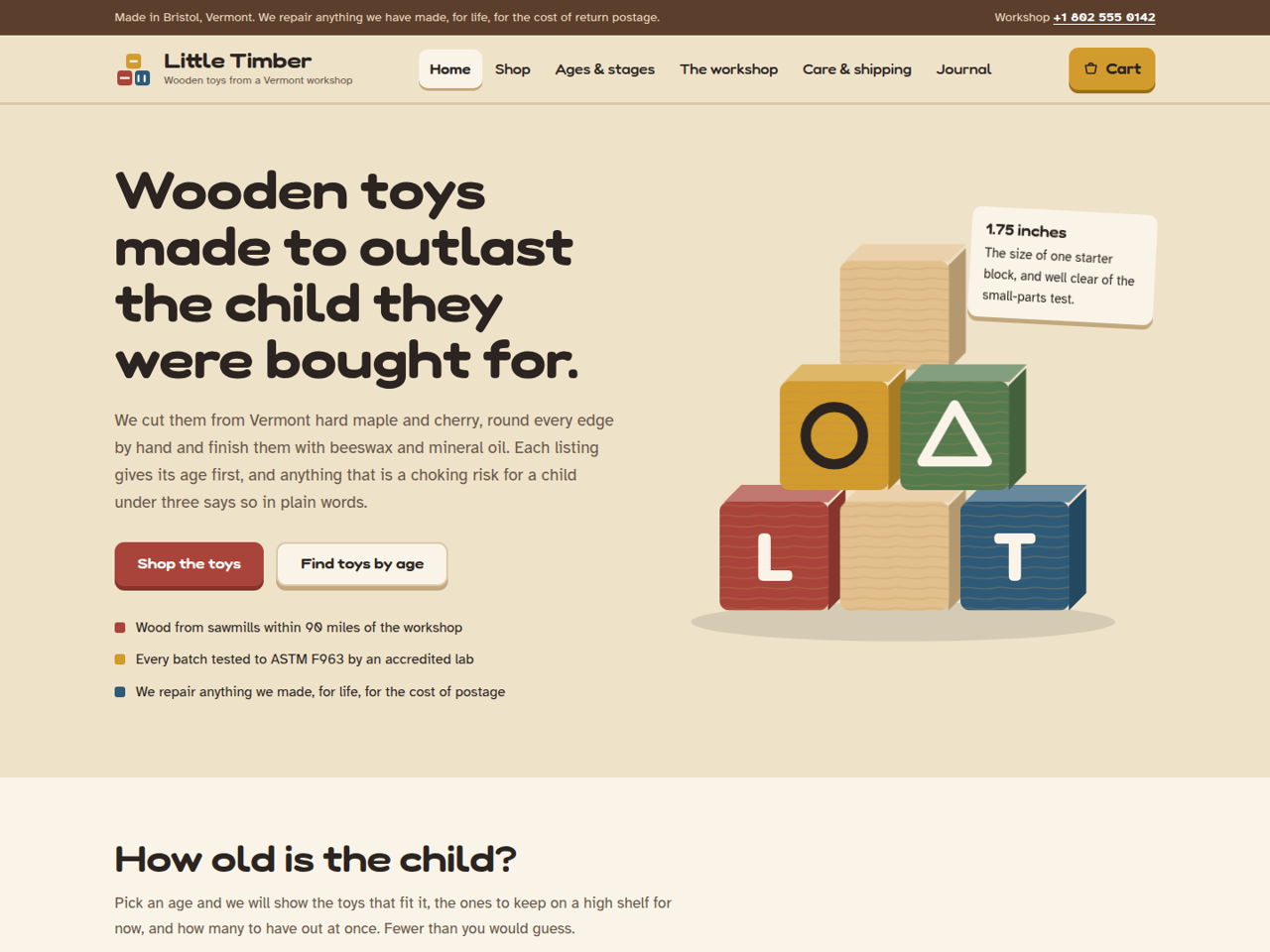
Wooden Toys is a complete online shop for a small toy workshop: four pages plus catalogue, product page, cart, checkout and a journal. It is built for the question every parent buying a wooden toy actually has — is this right for my child's age, and is it safe? — and for the answer most toy shops avoid: you probably need fewer toys.
Pages included
Home — a hero with a tower of toy blocks that drops into place, four chunky age blocks that open the finder at the right stage, two live product strips (featured and newest), a section arguing for owning fewer toys with the University of Toledo study behind it, the six real steps a block goes through, a blue band listing three situations where the shop talks you out of a purchase, the lifetime repair promise, and two letters from parents.
Ages & stages — the age & stage finder: pick 0–12 months, 1–2, 3–5 or 6+ and every toy is sorted into ready now, not yet and probably outgrown. For children under three, toys with choking-size parts are flagged in red with the plain reason (“each peg person is 1 in across”). Below it, the toy rotation planner: enter the age and how many toys the child has, and it gives the number to keep out, days between swaps and how many full shelves you own — and once you own more than four shelves' worth it tells you to stop buying and how many to pass on. Then the small-parts test explained with a drawing of the cylinder, and a table of the four stages.
The workshop — the four makers, the two woods and why, how each batch is lab-tested, and where $64 goes on a block set, line by line, summing exactly to the price.
Care & shipping — shipping table by region, caring for oiled wood, the four-step repair process, an accordion of weekly questions and a question form.
Shop, product, cart, checkout — catalogue with category chips, a product page with gallery, variant chips and an age-check panel, a cart with a helpful empty state, and a checkout with email, note and gift-message fields.
Journal — three articles: how many toys a toddler needs, the small-parts rule, and why only two woods.
Design and style. Birch-ply background, walnut ink, muted barn red, ochre, lake blue and moss. Fredoka set wide for headings, Atkinson Hyperlegible for reading. Buttons and cards are built like toy blocks, with a darker edge underneath that presses in when clicked. Every product photo is a hand-drawn illustration of the actual toy. The shared script carries the menu, the finder, the planner, gallery, variants and accordions — vanilla and null-guarded.
Before you publish. The finder reads each toy's ages from data-min, data-until and data-small on the Ages page; update them whenever you change the catalogue. The out-at-once numbers live in script.js and in the stage table, so change both. Replace the testing, sourcing and repair claims with your own — they are promises customers will hold you to. Forms use named inputs with no action, so PageHub attaches the handler on publish; sample products and articles are for the preview only.
Best suited to wooden and heirloom toy makers, children's furniture and nursery shops, Montessori and play-material sellers, and any shop for families where the honest answer is sometimes “not yet” or “you have enough”.
Aún no hay reseñas. Las reseñas vienen de quienes usaron esta plantilla de verdad.