
Vista previa de la plantilla
Abrir completa ↗
Toko Online
Hot Sauce Shop
«Usar» abre el panel de PageHub para que empieces con esta plantilla.
- Categoría
- Toko Online
- Tipo
- Sitio de varias páginas
- Páginas
- 4
- Tienda online
- Incluida
- Publicada
- 16 noviembre 2026
- Usada
- Nunca usada
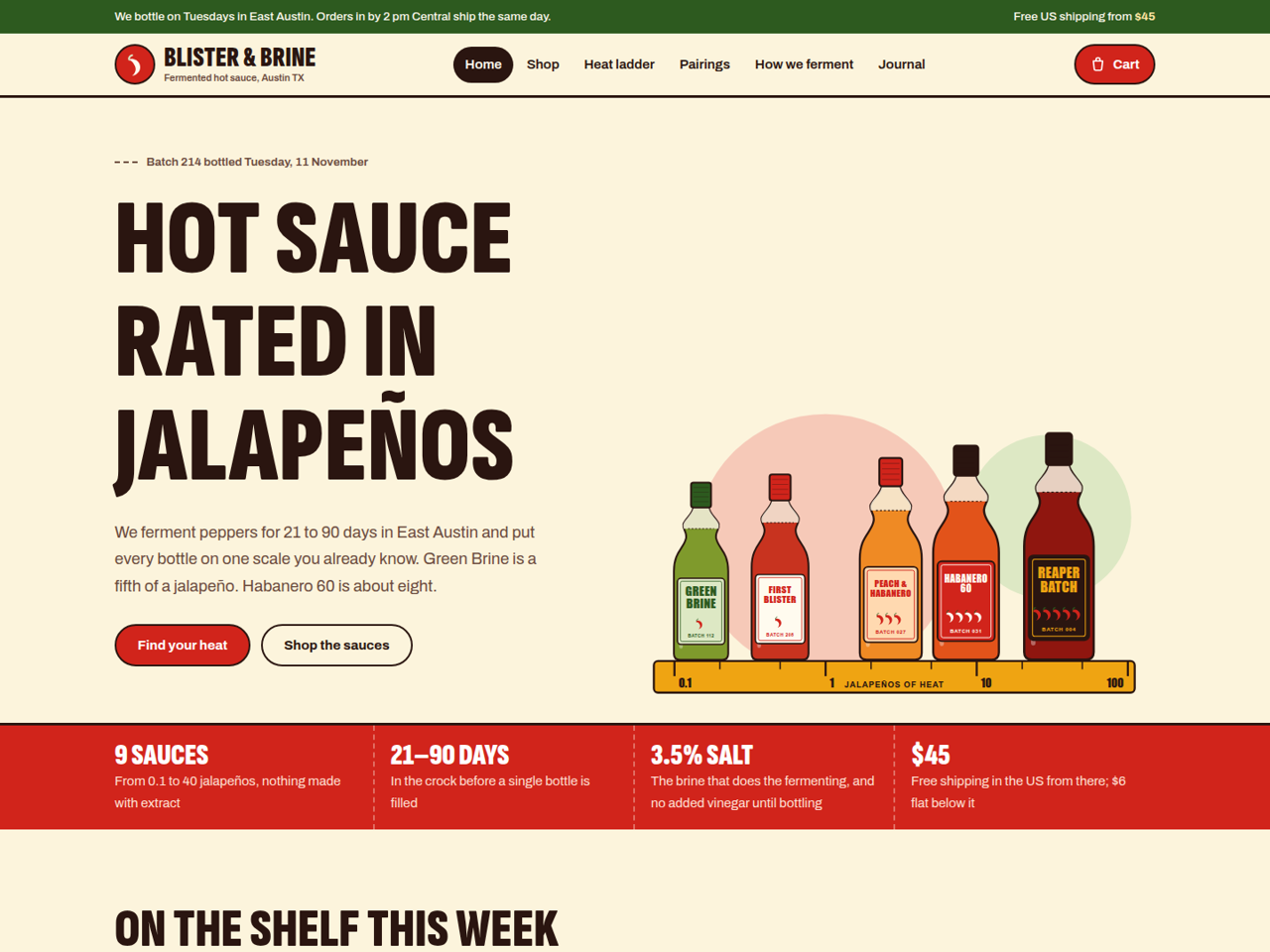
Hot Sauce Shop is a complete online store for a small-batch fermented hot sauce maker: four pages plus catalogue, product page, cart, checkout and a journal. It is built on one idea — every bottle rated in jalapeños, a heat scale people already know — and two working tools that will tell a buyer to skip a bottle when that is the honest answer.
Pages included
Home — a hero of bottles standing on a jalapeño ruler, a red fact band, two live product strips (featured and newest) whose cards each show a heat chip, a compact heat ladder, the four stages of a ferment, a pairing finder, and a plain list of who the shop is not for.
Heat ladder — the signature tool. Nine sauces and eight reference peppers drawn as ranges on a logarithmic scale. Pick the hottest thing you already enjoy and every sauce turns comfortable, a step up or too far for now, with a written verdict that names your ceiling — and says outright when nothing on the shelf will challenge you. Then how the figures are worked out (pepper range × share of the bottle, checked against two lab tests), the full table, and five questions.
Pairings — the pairing finder: thirteen dishes, each with a heat ceiling above which you stop tasting the food. It names one bottle and why, the ones that are fine for the dish but hot for you, and the ones that would simply be too hot for that dish. When nothing fits it says so and suggests lemon. Then the three rules it uses and a live best-sellers strip.
How we ferment — the process from day 0 to bottling day, an annotated bottle label (batch, date, fill line, heat), and shipping and returns, including a swap for one rung down if a sauce is too hot.
Shop, product, cart, checkout — catalogue with heat-tier category chips and a rubber-stamp sold-out mark, a product page with working gallery and a heat panel placing the bottle against one jalapeño and against the buyer's own ladder choice, a cart with plain shipping costs, and a checkout with email and a note field.
Journal — three long posts: why fermented sauce tastes milder than its number, how the ratings are worked out, and twelve dishes with the bottle for each.
Design and style. Styled like the bottle labels: fermented-chili red and brine green on a bright label-paper ground, Sofia Sans Extra Condensed over Archivo, ink rules, dashed fill lines and batch numbers. The shared script carries the menu, the ladder, the finder, the heat chips, the heat panel and the gallery — vanilla and null-guarded.
Before you publish. Every heat figure lives in one table at the top of script.js; the ladder, the finder, the card chips and the product heat panel all read it, and products are matched by name. A renamed product simply loses its chip rather than showing a wrong one. The table on the Heat ladder page is printed text, so change it together with the script. Replace the lab results with your own or remove them — they are claims buyers can hold you to. Forms use named inputs with no action, so PageHub attaches the handler on publish; sample products and articles appear in the preview only.
Best suited to hot sauce and chili makers, ferment and pickle producers, spice blenders, and any food shop where the right answer is sometimes “start with something milder”.
Aún no hay reseñas. Las reseñas vienen de quienes usaron esta plantilla de verdad.