
Vista previa de la plantilla
Abrir completa ↗
Webinar & Event
Hackathon
«Usar» abre el panel de PageHub para que empieces con esta plantilla.
- Categoría
- Webinar & Event
- Tipo
- Landing page
- Publicada
- 16 noviembre 2026
- Usada
- Nunca usada
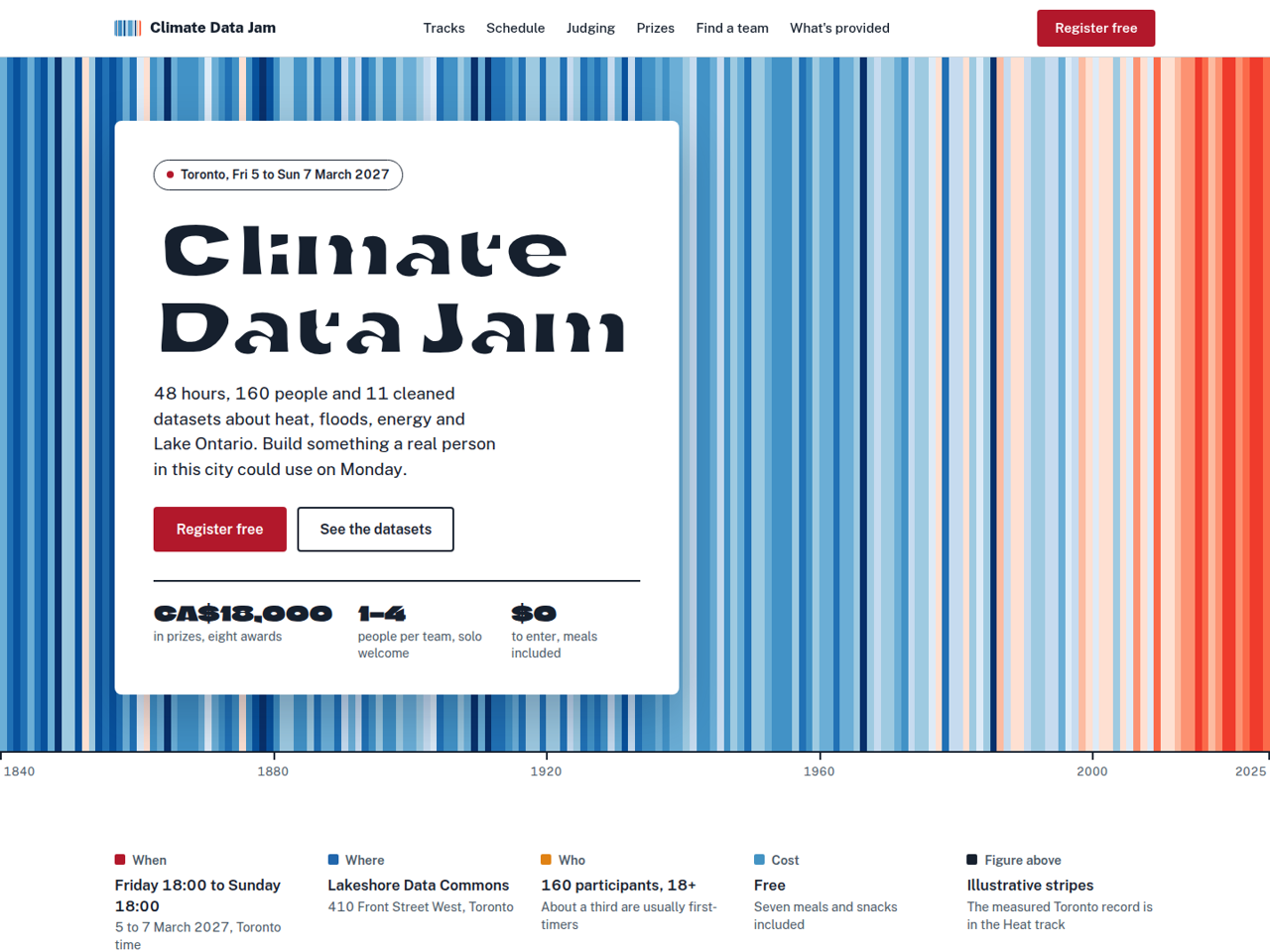
Hackathon is a landing page for a weekend data event: a 48-hour hackathon where people sign up alone or in teams, work from shared datasets and compete for prizes. The sample event is Climate Data Jam, a fictional climate-data hackathon in Toronto with prizes in Canadian dollars. Its structural decision is to answer the practical questions before anyone has to ask: what is happening right now, how projects are scored, what is and is not provided, and who you would be working with if you come alone.
Sections, in order
Sticky navbar with anchors and a register button; mobile menu.
Hero drawn as a chart: full-width warming stripes with a year axis underneath, and a white panel holding the event name, dates, a one-sentence promise, two calls to action and three figures (prize pool, team size, cost).
At a glance — when, where, who, cost, and an honest caption saying the stripes are illustrative.
Tracks — four challenge tracks, each with a small chart, the question it asks and a table of its sample datasets (format and size).
Schedule with now and next — a 48-hour list and a timeline bar with night bands. The panel computes what is on now and what comes next against a configurable start date, says how long until doors open before the event and that it has ended afterwards, and has a slider to preview any hour.
Judging — five weighted criteria drawn as a stacked bar. The script checks that the weights add up to 100% and shows a warning if they do not. A scoring demo turns 1-to-5 marks into a weighted score out of 100.
Prizes — eight awards as a bar list; the total pool is summed by the script and written into the hero as well, beside the rules that matter (no double wins, open licence, payout terms).
Team builder — choose solo, pair or full team, tick your skills and a track: it picks example profiles that fill the skills that track needs, shows coverage and remaining gaps, and can copy your choices into the registration form.
What we provide and what we don't — meals, loaner hardware, cloud credit and a quiet room versus laptops, beds, travel and remote participation, plus a code of conduct with reporting contacts.
Registration form — name, email, team size, track, skills, teammates, experience, dietary and access needs, age and code-of-conduct confirmations; then three next steps.
FAQ — six questions, and a simple footer.
Design and style. A data-visualisation look in a light theme: cool grey paper, deep navy ink and the blue-to-red warming-stripe scale used as real colour encoding for tracks, criteria and prizes. Headlines use Climate Crisis, a typeface whose letters thin out along a year axis; the hero title moves from 1979 to 2025 once on load (off when reduced motion is requested). Body text is Public Sans. Isolines and small hand-drawn charts are SVG files in the bundle. All interactions are vanilla JavaScript.
Before you publish. Set the start time and time zone in the data-start and data-tz attributes of the schedule section: the hero dates, the at-a-glance line, every time in the schedule and the now/next panel are computed from it. Event offsets are the data-h (hour) and data-d (duration) of each schedule row. Judging weights live in data-weight and prize amounts in data-amount; keep the weights at 100%. A few sentences mention weekdays (team lock, code cut-off, cancellation date), so read them again if you move the event. The team builder's needs and example profiles are in the script. The form has no action: PageHub attaches the submit handler on publish.
Best suited to hackathons, data jams, game jams, design sprints, civic-tech weekends and any timed event where people register individually and are grouped into teams.
Aún no hay reseñas. Las reseñas vienen de quienes usaron esta plantilla de verdad.