
معاينة القالب
فتح كامل ↗
Company Profile
One-Page Profile
«استخدم» يفتح لوحة PageHub لتبدأ من هذا القالب.
- الفئة
- Company Profile
- النوع
- موقع متعدد الصفحات
- عدد الصفحات
- 1
- متجر إلكتروني
- غير مشمول
- نُشر في
- 1 سبتمبر 2026
- الاستخدام
- لم يُستخدم بعد
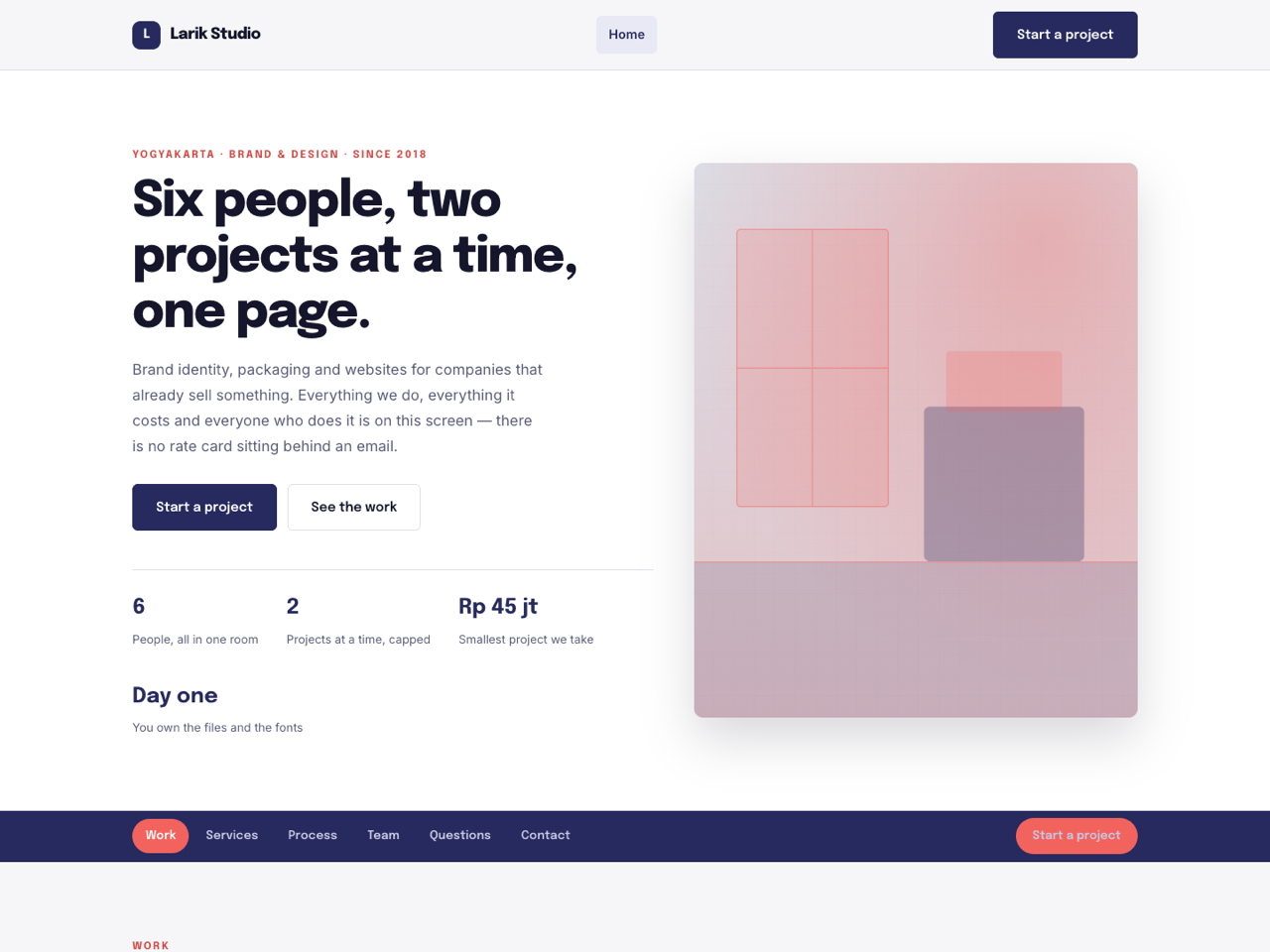
One-Page Profile is a genuine single-page website for a small studio or agency, built on the argument that six people do not have five pages of things to say. The working mechanism is a sticky section nav with scroll spy — necessary rather than decorative, because PageHub's site menu links to pages and this site has one.
What is on the page, in order
Hero — the studio in one sentence, four hard numbers including the smallest project it will accept, and the fact that clients own the files from day one.
The section nav — sticky under the header, scrolls horizontally on a phone, and marks the section you are actually looking at. The active link is decided by which section is nearest the top of the viewport, not by intersection ratios — the ratio approach picks nothing when a section is taller than the window, which most of these are.
Work — three projects, each with the weeks, the fee and what changed afterwards, because a portfolio that only shows artwork is asking you to judge taste.
Services — three services with real starting prices, closed by a paragraph saying who should not hire this studio and offering three freelancers instead.
Process — five stages on a dark band, where the second is paid discovery you can walk away with, and the third is "two directions, not six" with the reason.
Team — three of the six, named in the proposal and present at every presentation.
Clients — three quotes including one from a client who paid for discovery and then did not go ahead.
Questions — six answered plainly, including "can you start next week" (almost certainly not).
Contact — a form that asks what the business is trying to do rather than what you want made, plus what to do if your budget is below the floor.
Design and style. Midnight indigo and coral on a cool off-white, Epilogue over Inter, rounded cards, a translucent sticky header above a coloured section bar. The shared script carries the menu, the scroll spy, accordions, count-ups and a date guard — all vanilla and null-guarded.
Before you publish. This is a one-page site, so the site menu holds a single entry and the real navigation is the in-page bar — if you add pages later, add them to the menu and the two navigations will need reconciling. Every anchor in that bar must match an id on a section; the spy silently ignores links whose target is missing, so a renamed section leaves a dead link that still looks fine. The scroll-margin-top in the stylesheet is what stops a section landing under the two sticky bars — change it if you change either bar's height. The starting prices appear once each, but the Rp 45 juta floor is stated in the hero, the services note and the contact sidebar. Forms use named inputs with no action attribute, so PageHub attaches the handler on publish.
Best suited to design and creative studios, consultants and freelancers, small agencies, architecture practices, and any business whose entire offer genuinely fits on one screen — a one-page site is a discipline, not a shortcut.
What is on the page, in order
Hero — the studio in one sentence, four hard numbers including the smallest project it will accept, and the fact that clients own the files from day one.
The section nav — sticky under the header, scrolls horizontally on a phone, and marks the section you are actually looking at. The active link is decided by which section is nearest the top of the viewport, not by intersection ratios — the ratio approach picks nothing when a section is taller than the window, which most of these are.
Work — three projects, each with the weeks, the fee and what changed afterwards, because a portfolio that only shows artwork is asking you to judge taste.
Services — three services with real starting prices, closed by a paragraph saying who should not hire this studio and offering three freelancers instead.
Process — five stages on a dark band, where the second is paid discovery you can walk away with, and the third is "two directions, not six" with the reason.
Team — three of the six, named in the proposal and present at every presentation.
Clients — three quotes including one from a client who paid for discovery and then did not go ahead.
Questions — six answered plainly, including "can you start next week" (almost certainly not).
Contact — a form that asks what the business is trying to do rather than what you want made, plus what to do if your budget is below the floor.
Design and style. Midnight indigo and coral on a cool off-white, Epilogue over Inter, rounded cards, a translucent sticky header above a coloured section bar. The shared script carries the menu, the scroll spy, accordions, count-ups and a date guard — all vanilla and null-guarded.
Before you publish. This is a one-page site, so the site menu holds a single entry and the real navigation is the in-page bar — if you add pages later, add them to the menu and the two navigations will need reconciling. Every anchor in that bar must match an id on a section; the spy silently ignores links whose target is missing, so a renamed section leaves a dead link that still looks fine. The scroll-margin-top in the stylesheet is what stops a section landing under the two sticky bars — change it if you change either bar's height. The starting prices appear once each, but the Rp 45 juta floor is stated in the hero, the services note and the contact sidebar. Forms use named inputs with no action attribute, so PageHub attaches the handler on publish.
Best suited to design and creative studios, consultants and freelancers, small agencies, architecture practices, and any business whose entire offer genuinely fits on one screen — a one-page site is a discipline, not a shortcut.
لا توجد تقييمات بعد. التقييمات تأتي ممن استخدموا هذا القالب فعلًا.