A notebook for your jacket pocket that runs three weeks on one charge.
Fieldnote is a 6.1-inch e-ink notebook, 158 grams, with a battery-free stylus that parks in its spine. It runs one app, the notebook, and sends your pages to your own folder as PDF, SVG or Markdown.
€163,480 pledged towards a €120,000 goal.
The goal pays for steel injection-mould tooling, radio certification for the EU, UK and US, and the first 1,000 units. Everything above it goes to the stretch goals on the ruler, in that order, and each one is added to every device, including the early tiers.
Fieldnote gets made. Tooling, CE, UKCA and FCC certification, and the first production run.
A warm front light, adjustable from 2700 K to 6500 K, so you can write in a dark train or a tent.
A second colour. Chalk, a pale grey shell with a graphite stylus, chosen in the backer survey.
The notebook file format, documented and published, plus an SDK so anyone can write export plugins.
One app, one stylus, three weeks between charges.
We built Fieldnote for the notes you take standing up: on site visits, in a lab, at the back of a lecture hall. That meant pocket size first, and a battery that outlasts a work trip.
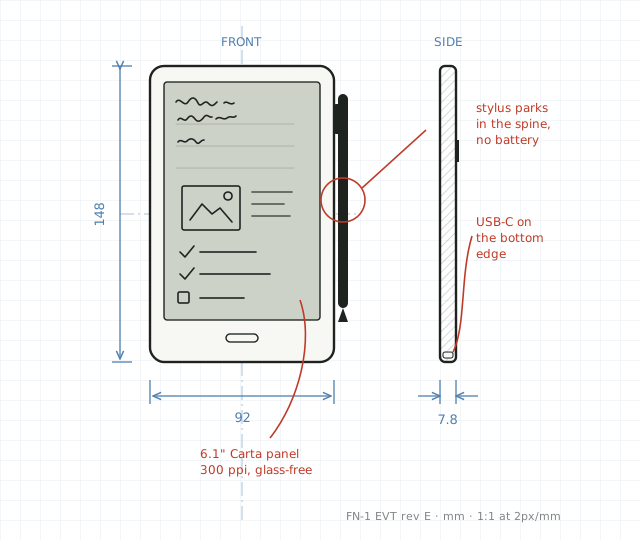
| Size | 92 × 148 × 7.8 mm, a little smaller than a paperback |
|---|---|
| Weight | 158 g with the stylus |
| Screen | 6.1-inch E Ink Carta 1300, 300 ppi, no glass layer, so the nib sits directly on the panel |
| Stylus | EMR, no battery and no pairing, 4,096 pressure levels, 21 ms ink latency |
| Battery | 1,800 mAh, about 3 weeks; USB-C, full in 2 hours |
| Storage | 32 GB, roughly 300,000 pages |
| Export | PDF, SVG and Markdown (handwriting recognised on the device, 14 languages), over USB or Wi-Fi to your own WebDAV folder |
| Shell | Glass-filled polycarbonate, graphite; second colour if €200,000 is reached |
What it deliberately leaves out
- A web browser and an app store. The firmware runs the notebook and a PDF reader for marking up documents.
- A Fieldnote account. Your pages leave the device only when you export them, to a folder you choose.
- Colour. Colour e-ink panels are dimmer and slower to draw on, and handwriting is where this device earns its place.
- A large screen. If you mark up A4 PDFs every day, a 10-inch tablet will serve you better.
Three of us in Ghent, Belgium: an industrial designer, an electronics and firmware engineer, and the person who answers your emails.
Five prototypes over two years, from card to rev E.
Every round fixed the thing that annoyed us most about the round before. The size never changed after the first one.
-
P1
Card and paper
Forty-one paper mockups carried in real pockets until 92 × 148 mm stopped falling out of any of them.
- Thick
- 2 mm
- Weight
- 9 g
-
P2
Dev board in a printed shell
An off-the-shelf e-ink kit in a 3D-printed box. It proved the screen; it also weighed as much as a phone.
- Thick
- 23 mm
- Weight
- 310 g
- Latency
- 80 ms
-
P3
Our own board, rev A
First custom circuit board. Ink latency halved; the battery was still a slab taped to the back.
- Thick
- 14 mm
- Weight
- 220 g
- Latency
- 48 ms
-
P4
Rev C, the stylus moves in
The stylus got its slot in the spine and the battery went flat under the board. Too thick for a shirt pocket.
- Thick
- 9.6 mm
- Weight
- 176 g
- Latency
- 29 ms
-
P5
EVT rev E, today
Glass-free panel, glass-filled shell, 21 ms ink. Twelve units built; two failed our drop test at the stylus clip.
- Thick
- 7.8 mm
- Weight
- 158 g
- Latency
- 21 ms
Pick a tier while the early ones last.
Every tier gets the same device, stylus, USB-C cable and two-year warranty, plus every stretch goal we reach. After the campaign Fieldnote will cost €329.
Super early bird
1 Fieldnote €189 All 200 claimed Wave 1Early bird
1 Fieldnote €219 61 of 400 left Wave 1Backer
1 Fieldnote €249 No limit Wave 2Pair
2 Fieldnotes, for two people or one and a spare €459€229.50 each 104 of 150 left Wave 2Studio five
5 Fieldnotes in one box, one invoice with VAT for the business €1,090€218 each 22 of 30 left Wave 2Wave 1 is planned for month 8 after the campaign closes, wave 2 for month 9. The delivery plan below says what could move those dates.
Work out your pledge before you commit to it.
Tier, extras and shipping to your region, with the tax you may pay at the door shown separately. Extras ship in the same box at no extra postage.
Your pledge
EU VAT is included. We are VAT-registered in Belgium.
When it ships, and what could push that back.
We have not manufactured at scale before.
We hand-built twelve EVT units. A run of 1,000 is a different job, so we hired a contract manufacturer in Shenzhen that builds e-readers for two European brands, and we have visited the line twice. We have paid a 30% deposit on 1,200 screen panels, which covers the first run. The dates below are our plan; the red notes are where we expect trouble.
-
Month 0campaign closes
Pledges charged, survey sent
The platform charges cards. Within two weeks you get a survey for your address, colour (if unlocked) and any extras you want to add.
Low riskFixed by the platform. Nothing for us to get wrong except the survey. -
Months 1–2DVT
Design verification, 20 units
Built from production-intent parts and put through drop, bend, battery and 10,000-insertion USB-C tests.
Known issueTwo of twelve EVT units cracked at the stylus clip in a 1.2 m drop. DVT adds a rib there. If it still cracks, add one month. -
Months 2–4tooling
Steel moulds cut, first shots
Six weeks to cut the tools, then first-shot parts flown to Ghent to check fit and finish.
Likely delayAlmost every tool needs corrections. We budgeted one round; a second costs about four weeks. -
Months 4–5certification
CE, UKCA and FCC testing
Radio and safety testing at an accredited lab in Germany, booked and paid for out of the goal.
Possible delayOur pre-scan passed radiated emissions with only 4 dB to spare. A failure means a board revision: six weeks. -
Month 6pilot
Pilot run of 100
Thirty go to backers who volunteer in the survey to report problems before everyone else gets theirs.
Our safety netProblems found here cost weeks. Found after wave 1, they cost a recall. -
Months 7–9production
Mass production, waves 1 and 2
Wave 1 (super early and early bird) ships in month 8, everyone else in month 9, from warehouses in the Netherlands and Los Angeles.
Out of our handsCustoms and the carriers. US duty on e-readers may change before we ship; we will post the figure before the survey closes.
If every red note above happens, wave 2 ships in month 15. We will post an update on the first of every month, including the months where nothing moved.
Questions backers have asked so far.
Something missing? Ask in the form below or write to hello@fieldnote.example. We answer within two working days.
Can I get my money back if you are late?
Until the pilot run in month 6 you can cancel and get the full pledge back. After that the money has been spent on parts for your unit, so we can only refund once it has shipped and you send it back, under the normal two-year warranty terms.
Does it sync to the cloud?
Only to a folder you own. Fieldnote exports over Wi-Fi to any WebDAV address (Nextcloud, a NAS, many hosting plans) or over USB as a drive. There is no Fieldnote server holding your pages.
Can I read books on it?
PDFs and EPUB files open for reading and annotation. The screen is 6.1 inches, so novels are comfortable and A4 documents are not. We would not buy it as an e-reader.
I am left-handed. Does that work?
Yes. Palm rejection works on either side, the toolbar moves to the right edge, and the stylus slot is reachable either way because it sits in the spine.
How long do the nibs last?
On our EVT units, one felt nib lasted three to five weeks of daily writing. The box includes five spares, which covers most people for the first six months.
What happens if you go out of business?
Your pages are already on your own storage in open formats. If we reach €250,000, the notebook format and SDK are published anyway; if we do not, we commit to publishing them if the company closes.
Hold a pledge, or ask us something first.
Send your details and we email you a link to the campaign page with your tier and extras already chosen, within one working day.
- Nothing is charged until the campaign closes, and only if it is funded. It is.
- Early bird places are not reserved by this form. 61 are left as of today's update.
- We send two emails at most: your link, and a reminder 48 hours before the close.