Which line can you read without squinting?
N24Most people over 45 stop somewhere below this one.
N14Mira Optics makes reading glasses from +1.00 to +3.00 in three frame widths, and posts them from Stockholm.
N10If this line takes effort at arm's length, the strength finder will give you a number in about two minutes.
N8If one of your eyes is worse than the other, it will tell you to see an optician first, and so do we.
N6This is about six point. At 40 cm, people whose near sight still works read it without leaning in.
N5Five point is the ingredients list on a jar of marmalade, and the reason most of our customers found us.
Sizes here are approximate because every screen is different. The finder calibrates the chart against a bank card first.
Your strength depends on two numbers: your age and your arm
The eye's own focusing shrinks steadily from childhood and runs out at around 60. A reading lens makes up the difference, and the closer you hold the page, the more it has to make up.
This table is the same arithmetic the strength finder runs. Find your age and the distance you read at.
| Age | Phone30 cm | Book40 cm | Laptop55 cm | Monitor70 cm |
|---|---|---|---|---|
| 45 | +1.50 | +0.75* | none yet | none yet |
| 50 | +2.00 | +1.25 | none yet | none yet |
| 55 | +2.75 | +2.00 | +1.25 | +0.75* |
| 60 and over | +3.25, beyond readers | +2.50 | +1.75 | +1.50 |
* Borderline. Our weakest lens is +1.00; try it only if small print tires you by the evening. Every figure assumes both eyes are about equal and that you see well in the distance without glasses.
Every strength is sharp at one distance
Once your own focusing has gone, a lens brings one distance into focus: a metre divided by its strength. A +2.50 book pair is sharp at 40 cm and soft at the laptop. Nothing about the frame changes that.
Usually between +1.50 and +2.50. Sharp from the pillow to the kitchen table, soft beyond.
Usually three quarters to a full dioptre weaker than your book pair. Our screen glasses come in +0.75 to +2.00, or plain, for that reason.
Varifocals do both in one frame, made to a prescription. If you would rather not swap pairs, that is the better buy.
Frames people keep coming back for
Every reader is made in nine strengths, +1.00 to +3.00. Every lens is anti-reflective and hard-coated, with a hard case in the box.




Three widths, because faces are not one size
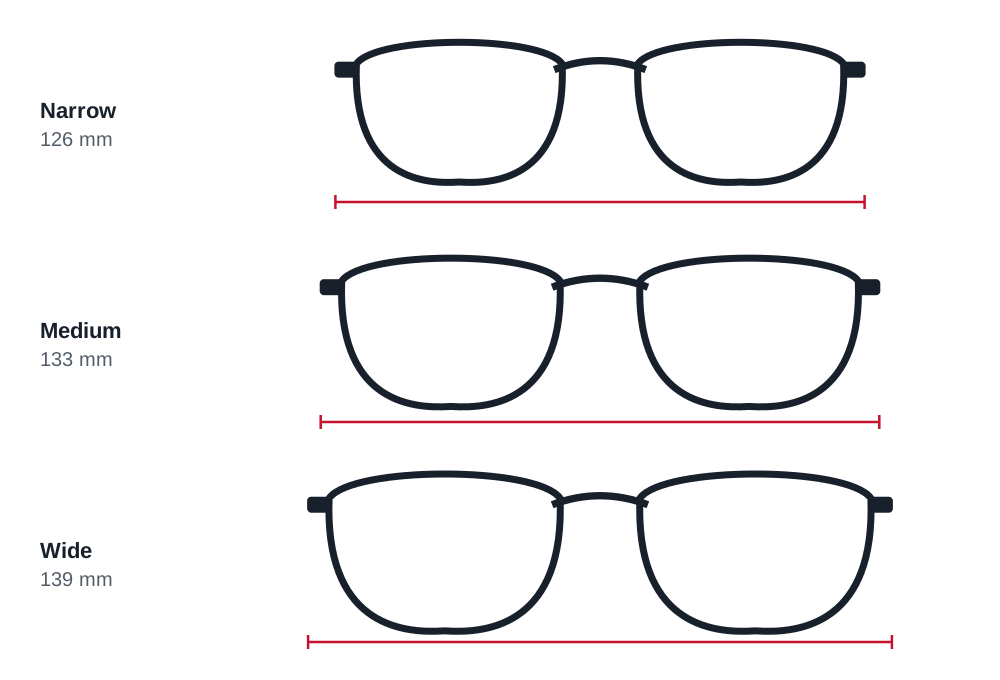
A frame that is too wide slides down your nose; one that is too narrow presses at the temples within the hour. Most shops sell readers in one width and call it universal. Ours come in three.
- Narrow
- 126 mm front, 49□18, 135 mm arms
- Medium
- 133 mm front, 52□19, 140 mm arms
- Wide
- 139 mm front, 55□19, 145 mm arms
Already own glasses that fit? The three numbers printed inside the arm are all the checker needs.
New from the workshop
The latest frames and the small things that make readers easier to live with.


When to skip us and book an eye test
Ready-made readers fix one thing: the slow, even loss of close focus that comes with age. Our lenses are the same strength on both sides with no correction for astigmatism. For anything on this list, they are the wrong purchase.
An eye test in Sweden usually costs 400–700 kr. If it ends with equal lenses in a strength we make, come back with the number.
- One eye is clearly worseCover each in turn while reading. Equal lenses will be wrong for one of them.
- Headaches or eye pain when you readA stronger pair is the wrong first answer to regular headaches.
- Your near sight changed in weeksAge-related change takes years. A fast one deserves an explanation.
- Bent lines, flashes or new floatersDo not order anything. Get seen the same day.
- You are under 40, or need more than +3.00Both are unusual enough to check before buying.
From the inbox
I ordered +2.50 because that is what the pharmacy pair was. The finder said +2.00 for the distance I actually read at. I went with the finder, grudgingly, and it was right: no more holding the paper at arm's length.
Margareta L., Uppsala. Vasastan reader, Medium
I asked for blue-light glasses for my whole team. They wrote back asking how far our monitors were and suggested half of us did not need glasses at all. Six pairs instead of twelve, and those six get worn.
Jonas W., Gothenburg. Kungsholmen, six pairs
Days to swap the strength, free
Readers are a best guess until you have worn them for a week. Send them back in any condition short of broken and tell us the new number.