Know what you’ll eat at kilometre 33 before you start.
We make gels, drink mixes, salt and bars in Boulder, Colorado. Before you buy any of it, the race planner works out how much you need each hour for your event, your weight and the weather, then writes it as a schedule you can tape to your top tube.
Racing for less than 75 minutes? You need water. The planner will tell you so.
Scroll sideways for the whole course.
Every plan comes down to three numbers an hour
Get them roughly right and the product choice is a matter of taste. Get them wrong and no gel will save the last hour.
Carbohydrategrams per hour
At marathon effort your stored glycogen lasts roughly 90 minutes. After that, what you swallow is what you run on, and running out feels like the legs being switched off around kilometre 30.
45 g for races of 75 minutes to 2½ hours, 60 g beyond that. Up to 90 g is possible on a bike, but only after weeks of practising it in training.
Sodiummilligrams per hour
Sweat carries somewhere between 300 and 1,500 mg of sodium per litre depending on who you are. White salt lines on your cap or shorts after a long run put you at the top of that range.
300 to 700 mg an hour in mild weather, scaled up by as much as 40% when it is hot. Most of it comes from the gels and drink; Salt Caps make up the difference.
Fluidmillilitres per hour
Enough to finish within about 2% of your starting weight. Losing a little is normal and harmless. Gaining weight during a race means you drank too much, which with too little salt is the dangerous direction.
400 to 800 ml an hour, adjusted for body weight and temperature. We never plan more than 800 ml without a measured sweat rate.
What most plans end up using
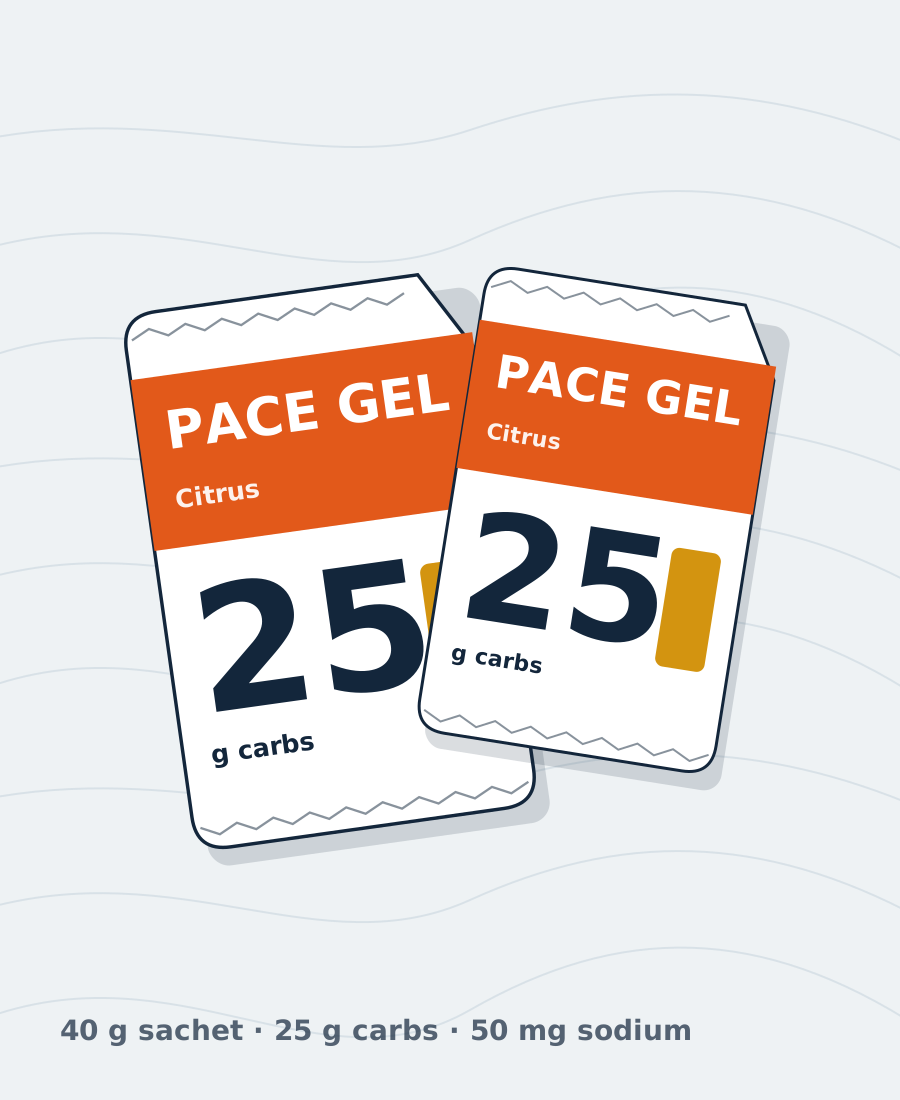
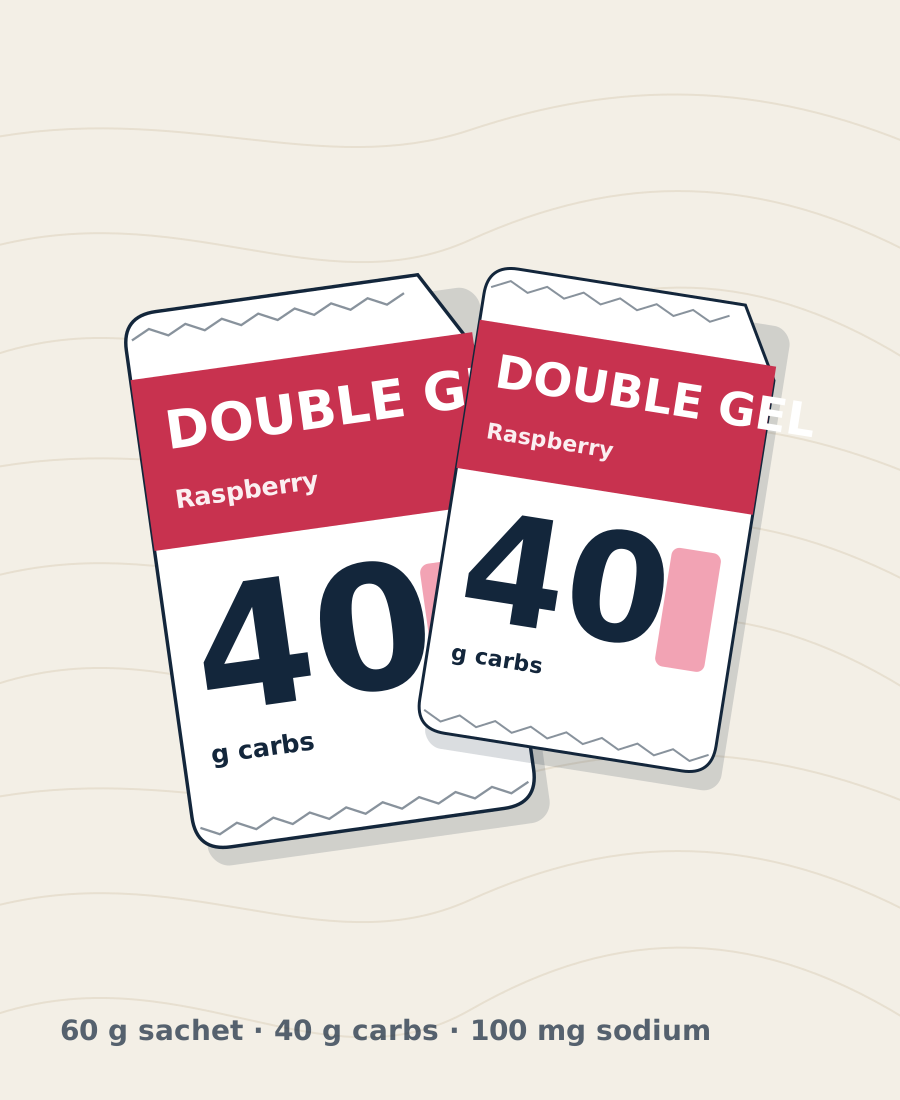
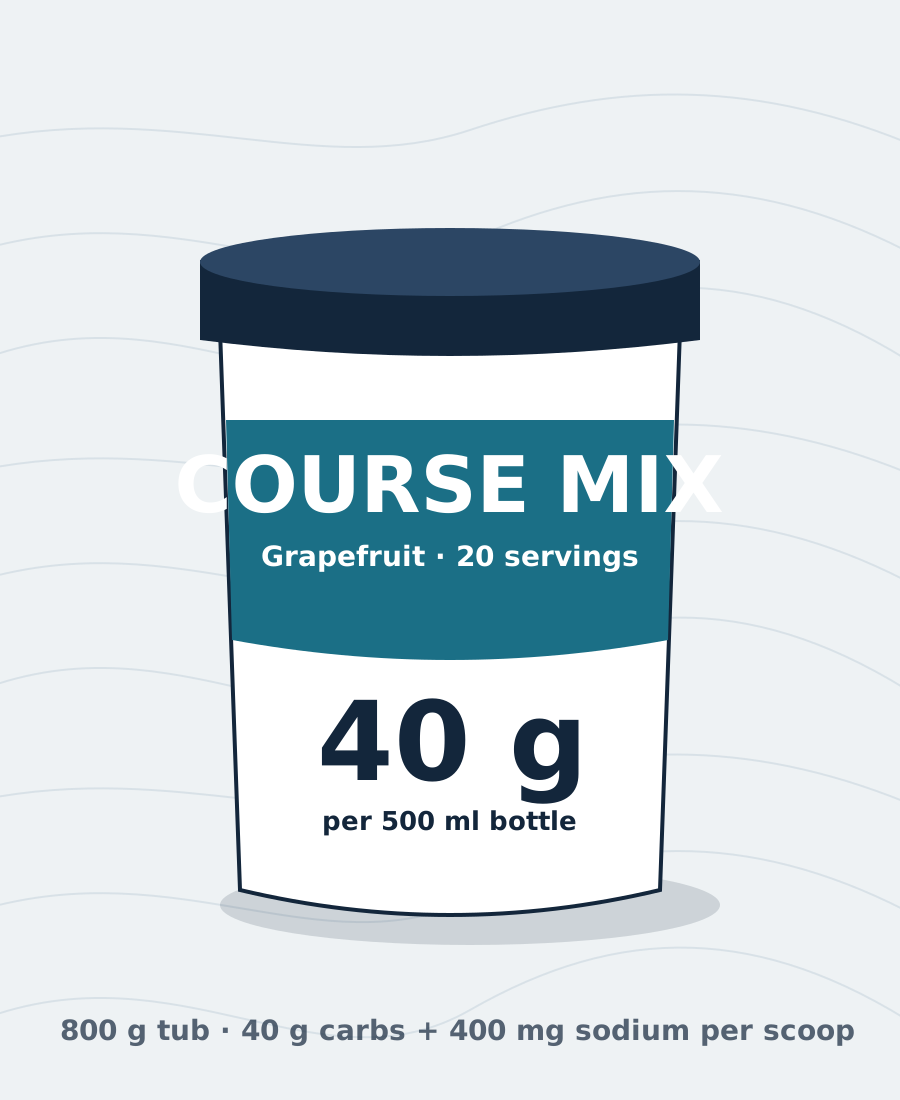
A 25 g gel for races under 2½ hours, a 40 g gel for longer ones, and a drink mix if you carry your own bottles.
Running a 10K? Keep your money.
Under about 75 minutes, the glycogen already in your muscles covers the effort. A gel at kilometre 6 of a 10K mostly adds a stitch. Eat a normal breakfast two to three hours before, drink to thirst, and spend the $2.50 on coffee afterwards.
- Under 1:15water, drink to thirst
- 1:15 to 2:30about 45 g carbohydrate an hour
- Over 2:3060 g an hour, up to 90 g with a trained gut
New for this season
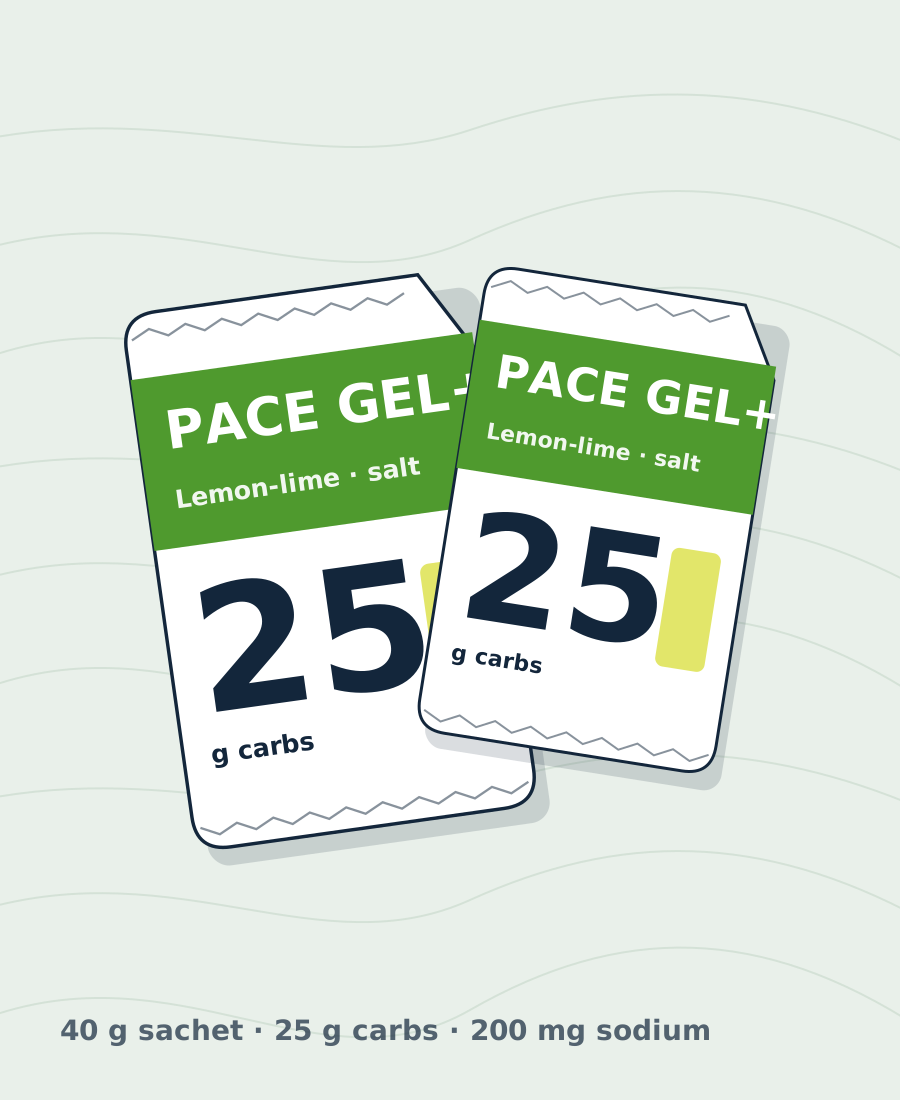
Including a high-sodium mix for August starts and a bar soft enough to chew at 5 °C.
Train your gut before race day
Your stomach adapts to carbohydrate the way your legs adapt to mileage. Most of the runners who tell us gels “don’t agree with them” tried 60 g an hour for the first time at kilometre 25 of a race.
Do it on your weekly long run, at or near race pace, with the exact products and flavours you will race with.
See the Gut Training Pack- Weeks 1–2
30–40 g an hour. One Pace Gel every 40 minutes, from minute 30.
- Weeks 3–4
45–60 g an hour. Add a drink-mix bottle or move to Double Gels.
- Weeks 5–6
60–80 g an hour, your full race plan. Only push towards 90 g if your race is longer than 2½ hours.
- If it hurts
Drop back a step for a week. Bloating means too much too fast, or too little water with each gel.
Mixed in Boulder, tested before it ships
A 2,400 square foot kitchen on the east side of town, a crew of nine, and a test lab two states away that sees every batch before we do.
- Ratio
- 2 parts glucose to 1 part fructose in every gel and mix. Two sugars use two different gates in the gut, which is what makes 60 g an hour and more possible.
- Batch
- Printed on every box, with the banned-substance test certificate behind it on request.
- Shelf life
- 18 months from mixing. We ship nothing with less than 12 months left.
- Allergens
- Gels and mixes are vegan and gluten-free. The bar contains oats and is made on a line that handles nuts.
I asked the planner about my 10K and it told me to buy nothing. Came back eight weeks later for the half and bought a box.
Maya R., Fort Collins half marathon, 1:52
Third Ironman, first one without walking the marathon. The difference was practising 80 g an hour on the bike for six weekends, not the gel itself.
Daniel O., Ironman Arizona, 11:48
The salt caps fixed the cramping I blamed on my fitness for two summers.
Priya K., Leadville 100 MTB, 10:31
Got a race on the calendar?
Tell the planner the event, your finish time and the forecast. It takes about thirty seconds and the answer is free even if it is “water”.