
One
The Wich, November 1796
The men brought Tom home on the door of the boiling house, because it was the only thing in the works wide enough to carry him flat, and Hester, who had been salting a ham at the back table, knew from the door before she knew from their faces.
She did not go out to them. She stood with her hands in the salt crock and let the cold of it climb her wrists, and she counted the men through the window as they turned in at the gate: four on the door, Abel Croft walking behind with his hat in his hands, and the boy Kit behind Abel with nothing in his hands at all, which was somehow the worst of it. A boy who had been told to carry something would have been told that there was something still to be done.
The flue under the third pan had gone at a quarter past six. That was what they told her, standing in her kitchen with the snow melting off their shoulders onto her floor. The brick had been bad for a year and Tom had said so, and Tom had gone under the pan to see how bad, and the pan had come down onto the fire with eight hundred gallons of brine in it and the steam had done the rest. Abel said it was quick. Abel was a poor liar and a kind man, and she let him have it.
They laid him on the table she had scrubbed that morning. Someone had covered his face with a sack that still said, in Tom's own stencil, VANE NORTHWICH WHITE. She left it there.
It was Abel who stayed, after. The others went back to the works because the other pans did not know that anyone had died and would boil dry by morning if left, and in the Wich that was a reason everyone understood. Abel sat by the fire in Tom's chair, which he would never have done if Tom had been able to see him, and turned his hat round and round by the brim.
"There's the load," he said at last.
"I know there's the load."
"Forty horses, missus. Holroyd's salt. It's to be in Halifax by St Thomas's Day."
She knew that too. She had written the letter. Tom could read well enough, but he wrote like a man fencing a field, every word a post he had to drive in, and so it had been Hester at this table in September who set down the terms in her small upright hand: forty loads of white salt, each of two hundredweight, delivered to Mr Lister Holroyd at the Cloth Hall, Halifax, before the twenty-first day of December, at eleven shillings the load. Four hundred and forty shillings. Twenty-two pounds. And under that, in a different letter to a different man, the thing she had not wanted to write and had written anyway: that the forty horses and their saddles and panniers were pledged to Mr Josiah Pemberton against thirty pounds, lent at Michaelmas, to be repaid at Christmas or the horses forfeit.
"There's eight pound in the tin," she said. "Eight pound and three shillings. I counted it Sunday."
Abel did the sum the way he did all sums, with his lips. She watched him arrive at it.
"Then it has to go," he said.
"Then it has to go."
"I can take it. Me and the boy, and Ned Fallows if his chest holds. It's been done short-handed before."
"It's been done short-handed in August." She took her hands out of the salt at last and wiped them on her apron, and they stung where the brine had found the cracks in her knuckles. "Have you been over Standedge in December, Abel?"
He had. She had known he had; Tom had told the story at their wedding, of the year the snow came down on the tops so fast that Abel walked the last four miles into Marsden holding the tail of the lead horse because he could not see its head. He did not tell it now. He looked at the fire.
"Pemberton won't wait," he said instead. "He'll have a man here the day after Christmas, and he'll bring a cart for the saddles."
"Then the salt goes," Hester said, "and I go with it."
She would think, later, on the long white tops above Saddleworth, that she had decided it there in the kitchen with Tom lying under his own sack. That was not quite true. She decided it in the night, which is where most decisions are made and where they are least often remembered, lying awake in a bed that was too wide now, listening to the works.
You could hear the salt from the house. Everyone in the Wich could; it was the sound you were born into, and so mostly you could not hear it at all. But that night she listened to it the way you listen to a clock when you cannot sleep: the low roar of the fires under the pans, the hiss where the brine met the iron, the scrape of the long rakes as the men drew the crystals to the side, and every hour the knock of the wooden moulds as the wet salt was pressed into blocks to dry. Forty horses' worth of it was already stacked in the hothouse behind the pans, white and hard and square, waiting. Two hundredweight to a horse. Four tons of salt, and four tons of reasons.
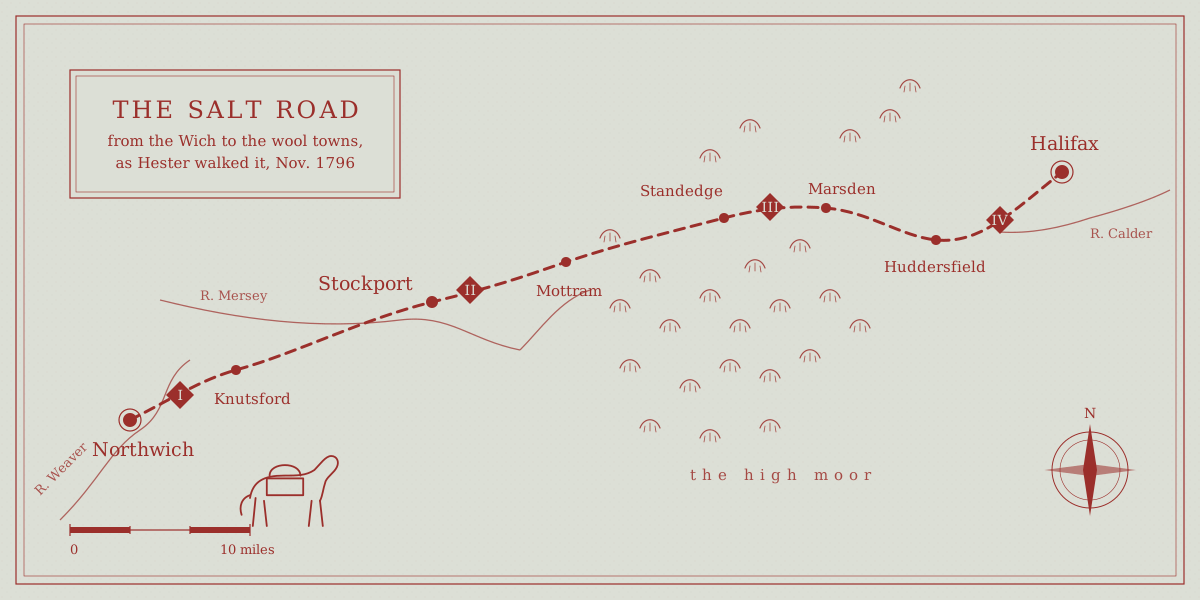
She thought of the road. She had never been further along it than Knutsford, which was a morning's walk and a market and a church with a crooked spire. Past Knutsford it was only names, the names Tom brought home with the mud on his boots: Stockport, where you crossed the Mersey on a bridge so narrow the horses went over one at a time; Mottram, where the inn kept a dog that hated jaggers; and then the tops, which Tom never called by any name at all, only the tops, the way a man might speak of a person he respected and did not like. Standedge. Marsden. The long drop into Huddersfield with the horses leaning back against the weight. And Halifax at the end of it, which he said was all hill and all wool, so that the whole town smelled of wet sheep and money.
Fifty-eight miles. Eleven days, if the weather held. It would not hold.
She had walked behind those horses a hundred times, out of the yard and down to the corner where the road turned east, and then she had always stopped and waved and gone back in to the fire, and Tom had always lifted his stick without turning round. She knew the order they went in. She knew that Bess led because Bess would not follow, that the grey called Parson had to be kept away from the bay mare or he would bite, and that the bells on the lead horse's collar were not for music but so the train could find itself in a fog. She knew, in other words, all the things you learn from the end of a road. She had no idea at all of what was in the middle.
Near four, the knocking of the moulds stopped and the night shift went home past her window, their clogs loud on the frozen ruts. One of them was singing. Then someone said something low and the singing stopped, and she understood that they were passing the house where Tom Vane was, and that the whole of the Wich already knew.
In the morning she cut her hair.
It was not a gesture. She had no one to make a gesture to. It was that a woman's hair, long and pinned, would be wet by noon on the first day and would not be dry again until Halifax, and she had seen what happened to men who walked the tops in wet clothes, because sometimes they came back to the Wich and sometimes, in the spring, other jaggers found them. She cut it to the length of her ear with the shears she used for the sheep's tails, and she put on Tom's second pair of breeches under her skirt and Tom's oilskin over everything, and she went out into the yard where Abel was already standing among the horses with his breath going up white in the lantern light.
He looked at her for a long moment. Then he looked at the horses.
"Bess leads," he said.
"Bess leads," said Hester, and took the halter from his hand.